Real Estate Transaction Timeline
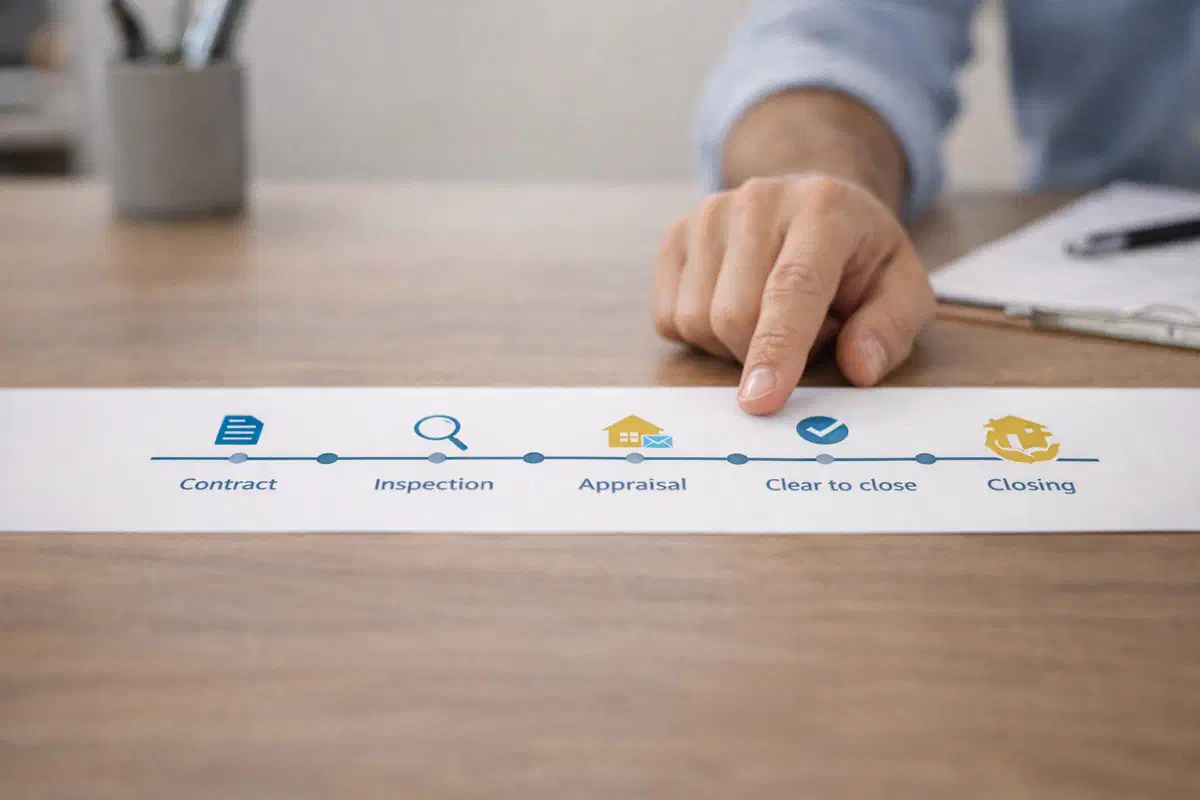
A standard financed residential transaction runs about 30 to 45 days from executed contract to closing, in five phases: contract and earnest money, inspections, financing and title, pre-closing, and closing. The dates shift with your contract terms, your state’s customs, and what comes up along the way, but the sequence is the same in almost every residential deal.
Table of Contents
▼We’ve laid this out as a day-by-day timeline for a standard 30-day financed close. Your transaction might be 45 days, 60 days, or a 3-day cash deal — the phases are the same, just compressed or expanded.
Want the task-level version? The real estate agent transaction checklist is the agent’s side, phase by phase; the transaction coordinator checklist is the TC’s side; and our free Contract to Close Checklist has 90+ items for both buyer and seller sides.
Timeline Template: 30-Day Financed Closing
| Phase | Days | Key deadlines | Who’s driving it |
|---|---|---|---|
| Contract and earnest money | 1–3 | Earnest money (and option fee, where the contract has one) delivered to the escrow holder | Buyer, escrow holder |
| Inspections and due diligence | 3–10 | Inspection or option period ends; repair amendment signed | Inspectors, both agents |
| Financing, title and appraisal | 10–20 | Financing approval deadline; title objection period; HOA document review | Lender, appraiser, title |
| Pre-closing | 20–28 | Clear to close; Closing Disclosure received at least 3 business days before closing | Lender, title |
| Closing | 28–30 | Signing, funding, recording | Title or closing attorney |
Your contract sets the actual deadlines. Put them on a calendar the day the contract is executed, counting the way the contract says to count.
Days 1-3: Contract and Earnest Money
What happens:
- Purchase contract is fully executed (signed by all parties)
- Earnest money (and option fee, where the contract has one) delivered to the escrow holder named in the contract
- Title company is notified and begins the title search
- Lender receives the executed contract and begins processing
- All parties, dates, and deadlines are entered into the tracking system
- Introductory emails go out to lender, title, and other agent
What to watch: Earnest money and option fee delivery deadlines. The contract sets them, and the clock starts at execution.
Days 3-10: Inspections and Due Diligence
What happens:
- Home inspection scheduled and completed
- Inspection report delivered and reviewed
- Additional inspections if needed (termite, structural, pool, septic, foundation)
- Option period deadline tracked (in states that have one)
- Repair amendment filled out only at the agent’s specific written direction (if applicable)
- Repair negotiation between agents
- Repair amendment executed
- Survey ordered
What to watch: Option period expiration is a hard deadline. Inspection findings drive the biggest negotiations of the transaction. Everything in this phase is time-sensitive.
Days 10-20: Financing, Title, and Appraisal
What happens:
- Lender orders appraisal (typically after option period clears)
- Appraiser visits property and delivers report
- Title commitment delivered by title company
- Title reviewed for exceptions, liens, or defects
- Survey delivered and reviewed
- HOA documents ordered and received (if applicable)
- Buyer selects homeowner’s insurance policy and provides binder to lender
- Lender processes loan through underwriting
- Underwriting conditions issued — borrower provides additional documents
What to watch: Appraisal value — if it comes in low, negotiations start immediately. Title defects — the earlier they surface, the more time to resolve. Lender conditions — borrower response time is often the bottleneck.
This is the quietest phase from the outside, but the most critical behind the scenes. A TC is following up with the lender, checking on title progress, confirming the survey is ordered, and making sure nothing is sitting in someone’s inbox waiting for action.
Days 20-28: Pre-Closing
What happens:
- Underwriting conditions cleared
- Clear to close issued by lender
- Closing Disclosure delivered to the buyer by the lender (the buyer must receive it at least 3 business days before closing)
- Closing date, time, and location confirmed with all parties
- Final walkthrough scheduled
- Wire instructions verified by phone (wire fraud prevention)
- Compliance file reviewed — all documents present and complete
What to watch: Clear to close timing — if the lender is late, the closing date may need to move. The Closing Disclosure’s 3-business-day window — a late CD can push closing. Wire fraud — the buyer should verify wiring instructions by phone, never from email alone.
Days 28-30: Closing
What happens:
- Final walkthrough completed
- Buyer wires funds to title company
- All parties sign closing documents
- Title company disburses funds
- Deed recorded at the county
- Keys transferred
What to watch: Funding and recording don’t always happen the same day. In some states, documents are signed at closing and funding happens afterward (a “dry” closing). Your title company or closing attorney will confirm how it works for your file.
Variations
Cash Transaction (7-14 days)
Remove the entire financing timeline — no lender, no appraisal (unless the buyer wants one), no underwriting, no closing disclosure timing requirement. Title work, inspections, and closing coordination are what drive the timeline. Everything compresses.
Even 3-day cash closes happen. Title does a rush search, inspections are waived or expedited, and everyone signs fast. There’s a rhythm to it once you’ve done enough of them.
New Construction (3-6 months)
The contract is executed but the house isn’t built yet. The timeline stretches to match the build schedule. Most of the transaction sits quiet between milestones — foundation pour, framing, systems rough-in, final inspections.
Activity ramps up in the final 30-45 days when the build nears completion and the transaction starts following the standard financed timeline: appraisal, final loan approval, closing disclosure, walkthrough, close.
Long-Dated Contracts (60-90+ days)
Relocation deals, seller leasebacks, or custom contract terms can push closing dates to 60, 90, or even 120 days out. The phases are the same — they just have more space between them. The middle stretch is mostly monitoring and reminding.
Why Timelines Slip
The most common delays:
- Lender delays: appraisal scheduling and underwriting conditions
- Borrower document delays: the buyer slow to answer the lender’s requests
- Inspection repair negotiations that run long
- Title defects that take time to clear
- Closing Disclosure timing: a late CD restarts the 3-business-day clock
When a closing date needs to move, an extension amendment gets filled out at the agent’s specific written direction and signed. It’s not ideal, but it’s routine. The goal is catching the delay early enough that everyone has time to adjust.
Since we’re watching the dates on everything, closings don’t sneak up on us. There’s no “suddenly” — we were watching it getting closer the whole time and we were prepared.
How the Timeline Changes by State
The phases above hold almost everywhere. What changes from state to state:
- The forms and the deadlines in them. Each state’s contract sets its own periods for inspections, financing, title review and earnest money.
- Who conducts the closing. Some states close through a title or escrow company; others use a closing attorney.
- When funding happens. At the closing table in some states, after signing in others.
- State disclosures and notices that have to be delivered along the way.
Our state guides walk through each one:
- Alabama
- Arizona
- Arkansas
- Colorado
- Florida
- Georgia
- Louisiana
- North Carolina
- Oklahoma
- South Carolina
- Tennessee
- Texas
Let Us Manage the Timeline
Every deadline, every follow-up, every document — tracked and managed so you can focus on your clients and your business. Sign a little paperwork, email us your contracts, and we’ll get started. Same day or next day.
Call: (713) 364-4382
Related Articles
- Real estate agent transaction checklist
- Transaction coordinator checklist
- Real estate closing process explained
- Contract to close: the complete guide
- Common transaction pitfalls
- Download the Contract to Close Checklist
Download the Complete Contract to Close Checklist
90+ action items across 4 phases, buyer and seller sides. Free — sent straight to your inbox.
We'll also send you occasional tips on transaction coordination — no spam, unsubscribe anytime.