


A seller’s disclosure is a written notice where the seller tells the buyer what they actually know about the property’s condition — defects, past repairs, flooding, insurance claims, additions built with or without permits. It’s a statement of the seller’s knowledge, not a warranty and not an inspection report. In Texas it’s required by statute for most residential resales, and it has to be in the buyer’s hands on or before the effective date of the contract.
Table of Contents
▼We see the seller’s disclosure on nearly every resale file we coordinate, and it’s one of the documents we specifically check for when a new contract comes in. Missing, unsigned, or late disclosures create termination rights that can hang over a transaction for weeks.
What the Disclosure Actually Covers
In Texas, the statutory basis is Property Code Section 5.008, which applies to sellers of residential property with not more than one dwelling unit. The notice walks the seller through the property system by system:
- Structure and systems — roof, foundation, plumbing, electrical, HVAC, and whether each has known defects
- Repairs and damage — previous fires, flooding, foundation repairs, termite treatment
- Water events — flood zone status, previous water penetration, and whether the seller has ever filed a flood or insurance claim
- Additions and modifications — work done with or without permits
- Environmental and site issues — settling, drainage problems, hazardous materials, landfill proximity
- Legal items — HOA membership and fees, lawsuits affecting the property, unrecorded liens
Two forms dominate in practice. The TREC form (OP-H) tracks the statutory minimum. The Texas REALTORS version (TXR-1406) asks quite a bit more — additional questions on insurance claims, previous inspections, and specific conditions. Listing agents overwhelmingly use the TXR version, and buyers are better off for it.
The standard throughout is the seller’s actual knowledge. A seller who genuinely doesn’t know about a slab crack under the carpet isn’t lying by leaving it unchecked. That’s also exactly why the disclosure doesn’t replace an inspection during the option period — the disclosure tells you what the seller knows; the inspection tells you what’s actually there.
The Delivery Deadline and the 7-Day Termination Right
The notice must be delivered on or before the effective date of the contract. That deadline — and the first termination right — comes straight from Texas Property Code §5.008(f):
- Delivered late — the buyer may terminate for any reason within 7 days after receiving it, and the earnest money comes back.

The TREC contract goes a step further. Paragraph 7B(2) of the TREC 1-4 Family Residential Contract adds the second right:
- Never delivered — the buyer may terminate at any time prior to closing, with the earnest money refunded.
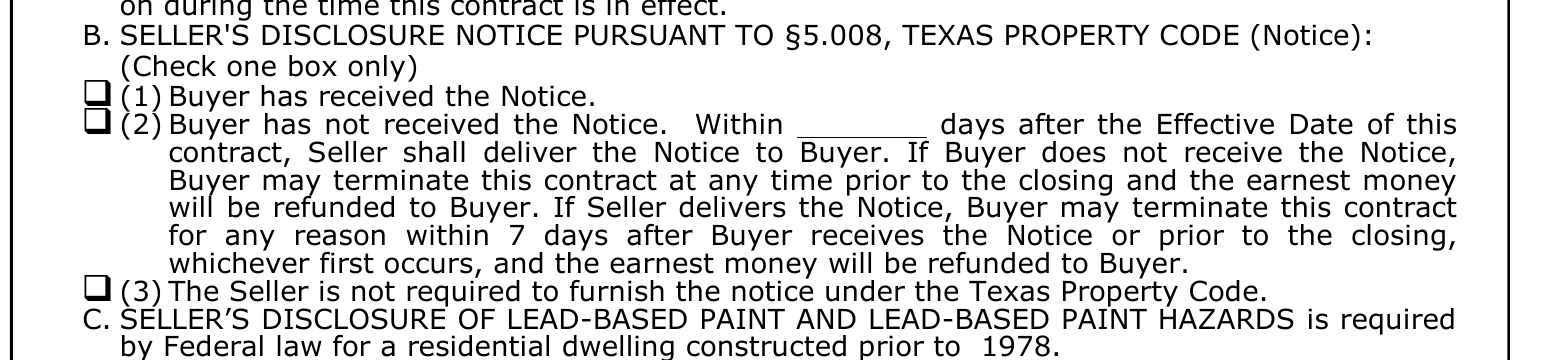
That second one surprises people. A missing disclosure means the buyer effectively carries a termination right through the entire transaction — long after the option period expired. We’ve seen deals where nobody noticed the disclosure was missing until the week of closing, which handed the buyer an exit nobody knew existed.
Who’s Exempt From the Disclosure Requirement
Section 5.008 lists specific transfers where no notice is required. The ones that actually come up:
- Foreclosures and trustee sales, and sales by a mortgagee who took the property back
- Court-ordered transfers — probate, bankruptcy, divorce decree, guardianship
- Transfers by an executor or administrator of an estate
- Transfers between co-owners, or to a spouse or lineal descendant
- Transfers to or from a governmental entity
- New homes never occupied — builder sales
The pattern behind the list: these are sellers who either never lived in the property or are transferring it in a context where personal knowledge of its condition isn’t the point. An heir selling an inherited house they never occupied is the classic example — exempt, though many still complete a disclosure noting their limited knowledge, which is generally smart practice.
Exempt doesn’t mean silent, either. Fraud rules still apply. A seller who affirmatively knows about a serious defect and actively conceals it has a problem regardless of any statutory exemption.
What Sellers Don’t Have to Disclose in Texas
A few items the statute specifically carves out, because buyers ask about them constantly:
- Deaths on the property by natural causes, suicide, or an accident unrelated to the property’s condition
- HIV/AIDS status of any previous occupant — protected under federal fair housing law
The property-condition thread runs through both carve-outs. A death caused by a defective condition — a collapsed deck, a faulty railing — circles back to disclosable territory, because the defect is the material fact.
Beyond the statute, the practical rule we see agents give sellers is simple: when in doubt, disclose. Disclosure disputes are one of the most common sources of post-closing litigation in residential real estate, and “I disclosed it and they bought anyway” is a much better position than “we didn’t think it was material.”
Where the Disclosure Fits in the Transaction
The seller’s disclosure is one of the first documents in the file and one of the first things a buyer’s agent should send their client. In a well-run transaction it’s delivered with or before the contract, acknowledged on the effective date, and referenced during the option period when inspection findings get compared against what the seller reported. Discrepancies between the disclosure and the inspection report are negotiation material — handled by the agents, not by us.
Texas updates its promulgated forms regularly, and the disclosure notice is no exception — we covered a round of changes in our article on 2023 seller’s disclosure updates. Staying current on form versions is part of file compliance: an outdated disclosure version in the file is the kind of detail that gets flagged in a broker compliance review.
If keeping every document in every file complete, current, and on time sounds like the part of the business you’d happily hand off, that’s literally what we do — see our contract-to-close service, or grab the free Contract to Close Checklist to see every item we track.
Related Articles
- Option Period in Texas — The buyer’s inspection window and how it works with the disclosure
- Texas Seller’s Disclosure Updates — What changed in the disclosure forms
- Texas Real Estate Closing Process — Where the disclosure fits from contract to keys
- TREC PID Disclosure Update — A separate disclosure requirement for PID properties
- Common Transaction Pitfalls — The file problems we see most often
