
The Addendum Behind Almost Every Financed Deal
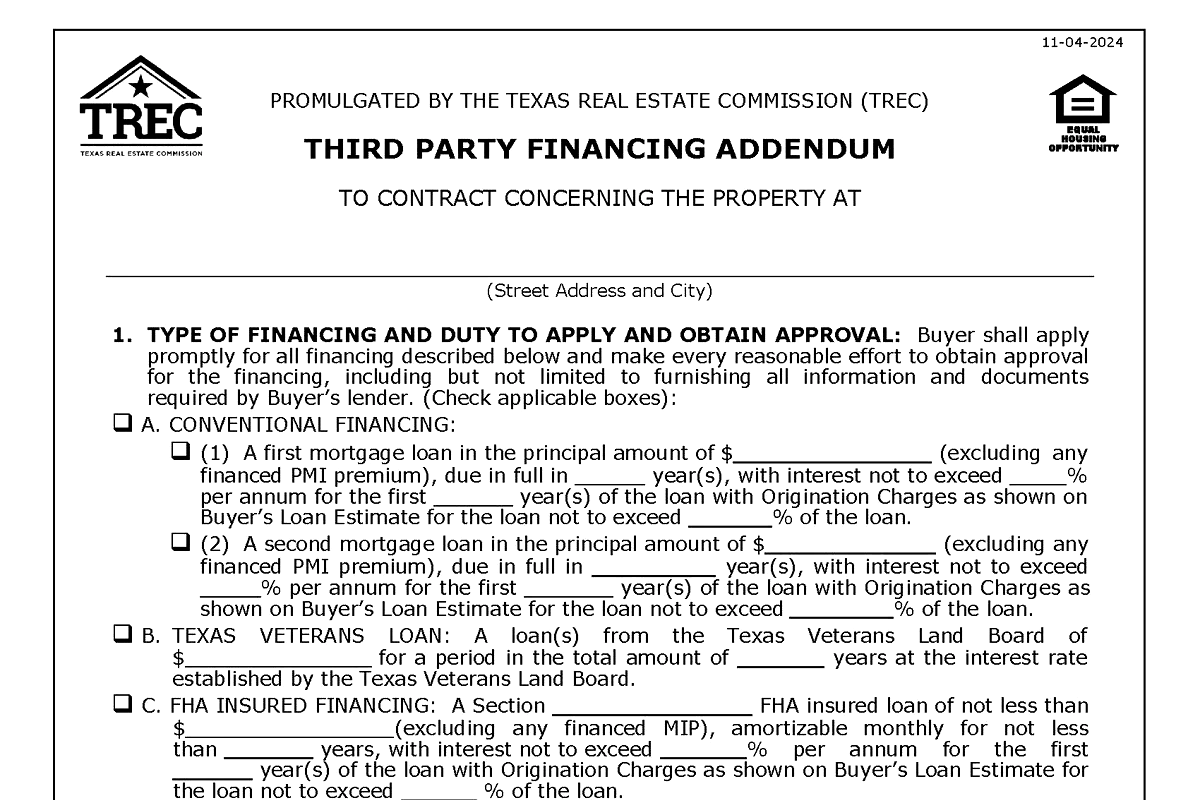
If the buyer is getting a loan from a lender, the Third Party Financing Addendum is attached to the contract. It sets the loan the buyer will apply for and the deadlines for walking away if the loan or the property doesn’t get approved.
The current version is TREC 40-11, which replaced 40-10. TREC lists it with an effective date of January 3, 2025. If an older version is still in someone’s template, swap it out.
For a TC, this form is mostly about two dates. Miss one and the buyer’s financing protection can quietly disappear.
Table of Contents
▼What the Addendum Covers
Paragraph 1: Type of financing. Check the boxes that apply: conventional (first and second mortgage), Texas Veterans Land Board, FHA, VA, USDA, reverse mortgage, or other financing. Each one has blanks for the loan amount, term, maximum interest rate and maximum origination charges as a percentage of the loan. Paragraph 1 also requires the buyer to apply promptly and make every reasonable effort to get approval, including furnishing what the lender asks for.
Paragraph 2: Approval of financing. Approval is deemed obtained when Buyer Approval and Property Approval are both obtained. The form says time is of the essence for this paragraph and strict compliance with the time for performance is required.
Paragraph 3: Security. If the buyer’s lender requires it, each note must be secured by vendor’s and deed of trust liens.
Paragraph 4: FHA/VA required provision. The appraisal protection for FHA and VA buyers. See the FHA/VA amendatory clause.
Paragraph 5: Authorization to release information. The buyer authorizes the lender to share the status of the loan approval with the parties and their representatives.
Check that the loan amount on the addendum plus the cash portion on the contract equals the sales price. It’s a common miss.
Buyer Approval vs Property Approval
This split is the heart of the form.
Buyer Approval (Paragraph 2A)
Buyer Approval is about the borrower. Under the form, it’s deemed obtained when the loan terms are available and the lender determines the buyer has satisfied all of its requirements related to assets, income and credit history.
There are two boxes; check one:
- Subject to Buyer Approval. If the buyer can’t get it, the buyer may terminate within a number of days after the Effective Date, by giving the seller notice of termination and a copy of the lender’s written statement of reasons. The earnest money is refunded. If the buyer doesn’t terminate within that window, the contract is no longer subject to Buyer Approval.
- Not subject to Buyer Approval. The buyer has no Paragraph 2A termination right at all.
Property Approval (Paragraph 2B)
Property Approval is about the house. If the lender determines the property doesn’t satisfy its underwriting requirements, “including but not limited to appraisal, insurability, and lender required repairs,” the buyer may terminate on or before the 3rd day before the Closing Date, with notice and a copy of the lender’s written statement. The earnest money is refunded. If the buyer doesn’t terminate under 2B, Property Approval is deemed obtained.
There’s no blank for this deadline. It’s tied to the Closing Date, so if closing moves, it moves.
The appraisal piece of 2B can be changed with the appraisal addendum (TREC 49-1). Lender-required repairs are also covered by Paragraph 7E of the resale contract; see lender-required repairs.
The Deadline Is the TC’s Job
Here’s why the Buyer Approval date matters so much. Under Paragraph 2A, if the buyer doesn’t terminate within the stated days, the contract stops being subject to Buyer Approval. If the loan is denied for credit or income reasons after that, the buyer no longer has that termination right, and the earnest money may be at risk.
That means the date has to be watched like the option period:
- On the deadline timeline on day one. Count from the Effective Date, not from when the lender got the file.
- Status from the lender before the date. Not on the date.
- A decision before the date. If the lender can’t confirm Buyer Approval in time, the buyer’s agent and the client need to decide, with time to spare, whether to ask for an extension or terminate.
What length to put in the blank is a negotiation between the agents and their clients. In our experience, 21 to 30 days is common, and the lender’s own estimate is the best guide.
An extension is a written amendment signed by both parties. The seller doesn’t have to agree to one. If it isn’t signed before the deadline passes, it doesn’t help. See what happens when you miss a contract deadline.
Financing Approval vs Clear to Close
These get used interchangeably, and they’re not the same.
Financing approval under the addendum is Buyer Approval plus Property Approval. Buyer Approval often comes early, sometimes as a conditional approval with a list of items still needed.
Clear to close comes later. Underwriting has signed off on every condition, and the lender is ready to send closing documents to title. It can come days, sometimes hours, before closing.
A file can have Buyer Approval on day 20 and not be clear to close until day 40. That gap is normal. The risk is in assuming the first one means the second is coming. Conditions get added, the appraisal comes in, an employment check shows something new.
When your buyer’s lender says “approved,” ask: approved for what? Buyer Approval as the addendum defines it, a conditional approval, or clear to close?
What the Addendum Does and Doesn’t Cover
The Paragraph 2A right runs on a deadline. It only protects the buyer if notice is delivered by the Buyer Approval date.
Cash means cash. If the contract has no financing addendum and the buyer decides to get a loan, that’s the buyer’s risk. The contract terms don’t change.
Seller financing is a different form. When the seller carries the note, it goes on TREC’s Seller Financing Addendum, not this one. The note and deed of trust are documents for an attorney.
If the buyer and seller disagree about whether a financing termination was valid, that’s a question for a real estate attorney.
How Our TCs Handle It
We fill out the Third Party Financing Addendum only at your specific written direction: the loan type, amounts and the Buyer Approval days come from you, your client and the lender. We don’t pick the terms or advise on them.
Then we:
- Send it to you to review and take to your client, and track signatures
- Introduce ourselves to the lender, title and the co-broke agent once the contract is executed
- Put the Buyer Approval deadline and the Property Approval deadline (3rd day before closing) on the deadline timeline, with 48-hour reminders to you
- Check in with the lender on status ahead of each date, and send weekly updates to title, the lender and the co-broke agent after the option period
- Track the appraisal and any lender-required repairs
- Show both dates on the Monday key-dates report and loan status on the Thursday status report
- Fill out an extension amendment or a termination notice only at your specific written direction if it comes to that, and deliver it once signed
You’re copied on everything. What to do when the lender is slow stays with you, your broker and your client.