The Seller’s Disclosure in Your Listing Packet May Be the Old One
TREC changed the Seller’s Disclosure Notice again in 2026. The current form is TREC No. 55-1, and it asks seven questions the 2023 version didn’t: insurance, windstorm coverage, private roads, storage tanks and conservation easements. If your listing packet, your forms software template or your brokerage’s intake folder still has 55-0 in it, sellers are signing a disclosure that skips those questions.
This page is the current guide: what changed in 2026, what’s on the form now, the 2023 change before it, and the separate water disclosure that arrived at the same time. Form numbers, dates and quotes come from TREC’s Seller’s Disclosure Notice page, the forms themselves and Texas Property Code Section 5.008.
It’s a practical summary, not legal advice. Questions about what a particular seller has to disclose go to a Texas real estate attorney.
Table of Contents
▼What Is the Current TREC Seller’s Disclosure Form?
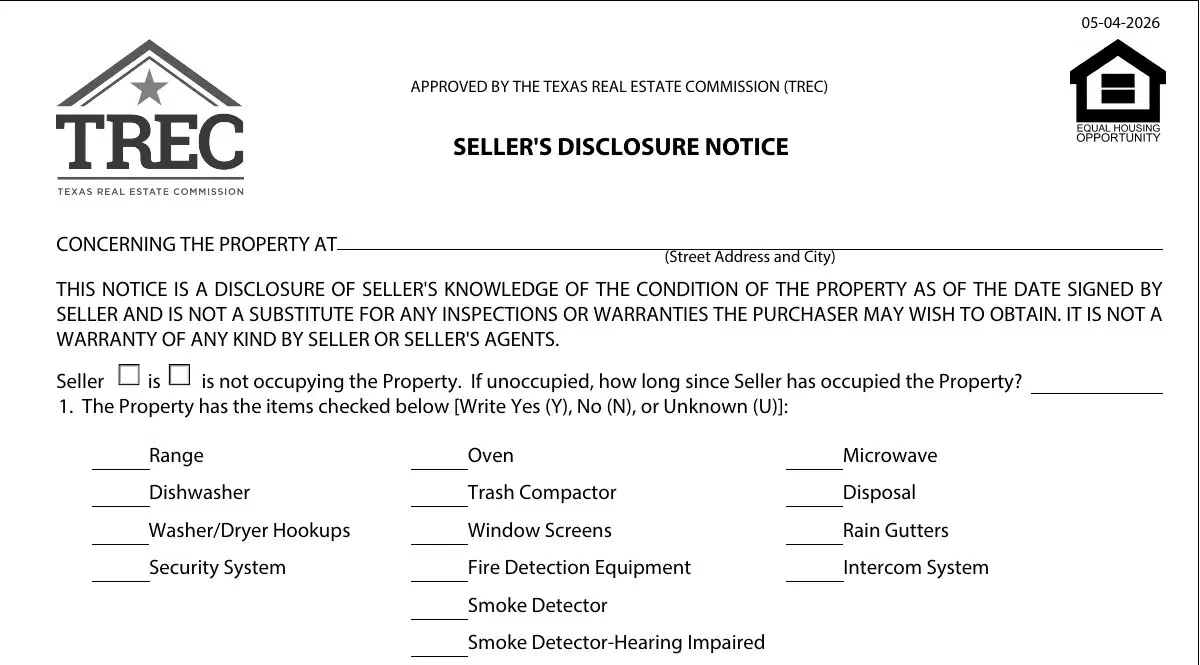
The current form is the Seller’s Disclosure Notice, TREC No. 55-1. It’s dated 05-04-2026, and TREC’s forms page lists it with an effective date of May 28, 2026. The footer says “This form replaces 55-0,” the version dated 09-01-2023. It’s four pages, signed by the seller, with a receipt acknowledgment for the buyer.
Check the footer, not the file name. Every page of the current form has “TREC No. 55-1” at the bottom and 05-04-2026 at the top. A PDF saved as “sellers-disclosure-2026.pdf” can still be the old form inside.
What Changed on the Seller’s Disclosure Notice in 2026?
TREC added seven items to Section 9, the “Are you (Seller) aware of any of the following?” list. Apart from the form number, date and footer, nothing else changed; TREC’s redline shows the additions as one block at the end of Section 9. Straight from the form, the new lines are:
- “Any conservation easements located on the Property,” with a definition: an easement, permanent or for a period of years, that restricts the use of all or part of the property “to protect natural resources, wildlife habitat, open space, or historical sites.”
- “The Property is presently covered by insurance.”
- “The Property is presently covered by windstorm insurance.”
- “Seller has been unable to insure the Property for any reason.”
- “A private road on or adjoining the Property for which Seller is financially responsible for maintaining.”
- “Any aboveground or underground storage tanks on the Property,” with a pointer to 30 Texas Administrative Code Chapter 334 for additional disclosure requirements.
- “Any aboveground storage tanks on the Property that hold 500 gallons or more and have stored petroleum products or other chemicals.”
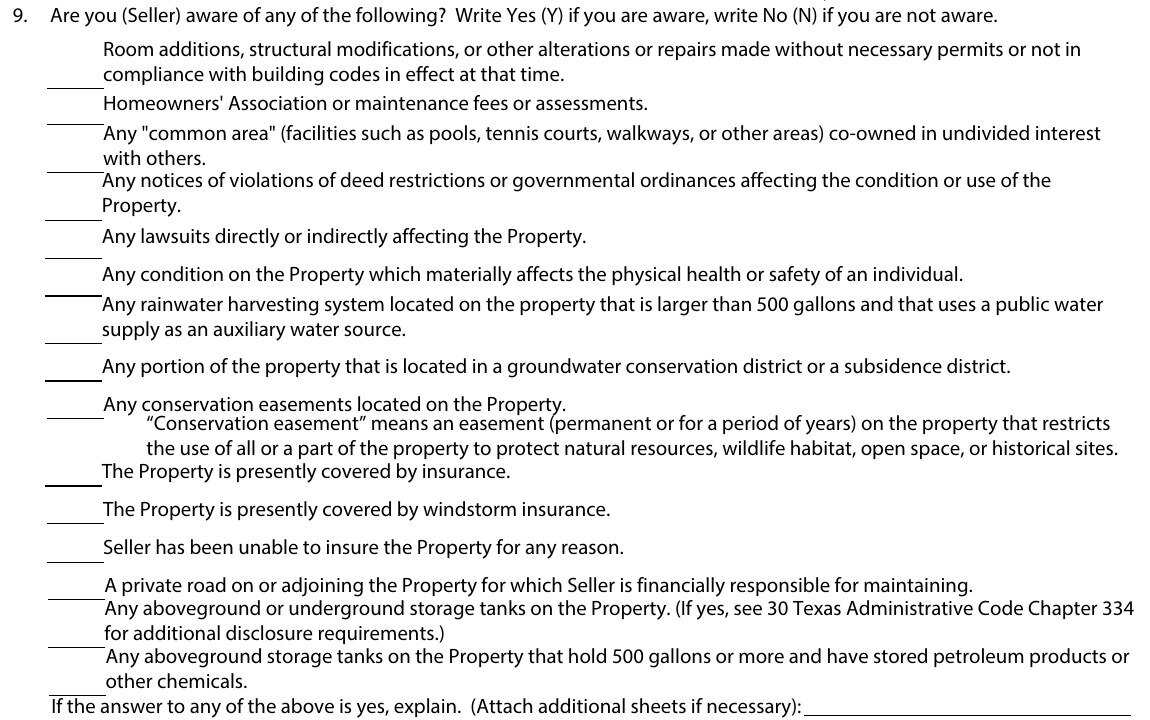 TREC No. 55-1 (05-04-2026), page 4, Section 9. The last seven lines are new in 2026. Source: Texas Real Estate Commission.
Like every Section 9 item, each one is answered Y or N, and any “yes” gets explained in the lines below.
Why TREC added them
TREC’s February 2026 meeting summary says the Seller’s Disclosure Notice was updated “to include information about property insurance and windstorm coverage, private road maintenance responsibilities, above ground storage tanks over 500 gallons, and conservation easements, as directed by the Sunset Advisory Commission.” (TREC, February 25, 2026)
Here’s the part most people miss: these seven items aren’t in the statute. Property Code Section 5.008 sets the minimum a seller’s disclosure has to contain, and it wasn’t amended for this. TREC’s Broker-Lawyer Committee noted in 2025 that it had historically not added anything to the TREC notice beyond what the statute spells out, and drafted these additions because of the Sunset directive (TREC, June 18, 2025).
That matters if your brokerage uses a different disclosure form. Section 5.008 allows a notice “substantially similar” to the statutory one that contains, at a minimum, all of its items. Whether a non-TREC form should now include the 2026 questions is a question for your broker or an attorney, not something to guess at.
What the new answers mean on a file
- Insurance answers get read closely. A “no” on “presently covered by insurance” or a “yes” on “unable to insure” is the kind of answer a buyer’s lender and insurance agent will ask about. Better to see it on day one than in the last week.
- Windstorm coverage matters on coastal files, where it’s often a separate policy.
- Private roads tell the buyer there’s a maintenance cost that won’t show up on the tax bill.
- Storage tanks come up on rural property, older commercial-adjacent lots and anywhere with a fuel tank on site.
- Conservation easements restrict what the buyer can do with the land. They’re usually recorded, so title may find them too, but now the seller says so up front.
Where Can I Get the TREC Seller’s Disclosure PDF?
From TREC directly: the Seller’s Disclosure Notice page links the current PDF and a redline of the 2026 changes. The direct PDF link is trec.texas.gov/sites/default/files/pdf-forms/55-1.pdf. If you use forms software, open the form and confirm the footer reads TREC No. 55-1 before it goes to the seller.
What’s on the Seller’s Disclosure Notice Now
The 55-1 follows the statutory notice in Section 5.008 section by section, plus the 2026 additions. In order:
- Occupancy. Whether the seller is occupying the property, and if not, for how long.
- Section 1: Property items. Appliances, systems and features marked Y, N or U (unknown): smoke and carbon monoxide alarms, HVAC, plumbing, septic or public sewer, pool and spa equipment, gas lines, fuel gas piping (black iron pipe, CSST or copper), garage, water heater, water supply (city, well, MUD or co-op), and roof type and age. Then: are any of these not working, defective or in need of repair?
- Section 2: Smoke detectors. Whether working smoke detectors are installed under Chapter 766 of the Health and Safety Code, with the hearing-impaired detector rule spelled out.
- Section 3: Known defects in walls, ceilings, floors, doors, windows, roof, foundation, driveways, plumbing, electrical and other structural components.
- Section 4: Conditions. Termites and wood rot, previous structural or roof repair, hazardous waste, asbestos, radon, lead-based paint, aluminum wiring, previous fires, drainage, unplatted easements, a single blockable main drain in a pool or spa, and previous use for methamphetamine manufacture.
- Section 5: anything else in need of repair.
- Section 6: Flood. Present flood insurance, previous flooding from a reservoir release, previous water penetration from a natural flood event, and whether the property is wholly or partly in a 100-year floodplain, 500-year floodplain, floodway, flood pool or reservoir, with definitions.
- Section 7: any flood damage claim with any insurer, including the NFIP.
- Section 8: any FEMA or SBA assistance for flood damage.
- Section 9: Other matters. Unpermitted work, HOA fees, common areas, deed restriction violations, lawsuits, health or safety conditions, rainwater harvesting systems over 500 gallons, groundwater conservation or subsidence districts, and the seven 2026 items above.
- Sections 10 and 11: notices about coastal property (Open Beaches Act and Dune Protection Act) and military installations.
- Signatures: seller signs and dates; the buyer signs to acknowledge receipt.
Section 5.008(d) sets the standard: the notice is completed to the best of the seller’s belief and knowledge as of the date it’s signed, and a seller who doesn’t know can say so. For what goes in it and why, see our explainer, What Is a Seller’s Disclosure?
Is a Seller’s Disclosure Required in Texas?
For most resales, yes. Property Code Section 5.008 requires a seller of residential property comprising not more than one dwelling unit to give the buyer a written disclosure notice, delivered on or before the effective date of the contract. If it comes later, the buyer may terminate for any reason within 7 days after receiving it.
The TREC contract adds one more right. Paragraph 7B of the One to Four Family Residential Contract (20-19) says that if the buyer never receives the notice, the buyer may terminate any time before closing, with the earnest money refunded.
Section 5.008(e) lists the exemptions, among them transfers under a court order or foreclosure sale, by a trustee in bankruptcy, by a fiduciary administering an estate, guardianship or trust, between co-owners, to a spouse or a person in the lineal line of consanguinity of a seller, to or from a governmental entity, a new home never occupied, and property where the value of any dwelling is no more than 5% of the property’s value. When the seller is exempt, Paragraph 7B(3) of the contract is the box that says so.
The Water Disclosure Is a Separate Form
The 55-1 already asks whether any part of the property is in a groundwater conservation or subsidence district. That question didn’t go away. What’s new in 2026 is a second, separate disclosure: the Seller’s Disclosure about Groundwater and Surface Water Rights (TREC 61-0), effective July 1, 2026.
Unlike the Seller’s Disclosure Notice, the water disclosure isn’t required by statute. It’s required by the TREC contracts (other than the condominium contract) unless the seller checks the box saying every exception condition is true. Being exempt from one doesn’t make a seller exempt from the other. We cover when it’s required, what it asks and the mistakes we’re already seeing in our guide to the Texas groundwater and surface water rights disclosure.
What Changed on the Seller’s Disclosure in 2023?
The 2023 change was one line in Section 1: fuel gas piping. Sellers now mark whether the property has black iron pipe, corrugated stainless steel tubing (CSST) or copper. It came from HB 697 of the 88th Legislature, which amended Section 5.008 effective September 1, 2023, and TREC told license holders to use the revised notice for contracts executed on or after that date (TREC, August 30, 2023).
Most sellers have no idea what their gas piping is made of. That’s fine. TREC’s guidance was that sellers who don’t know can mark “unknown,” and that inspectors have been required to note the type of fuel gas piping in their reports since 2022, so a recent inspection report may answer it.
In TREC’s 2026 redline, the form 55-1 replaces is 55-0, dated 09-01-2023, and 55-0 is shown as having replaced the older OP-H. If someone hands you an OP-H today, it’s out of date.
The Consumer Protection Notice
The other form TREC updated in 2023 is the Consumer Protection Notice. The current version is CN 1-5, effective September 1, 2023, and it’s still the current version. The 2023 change removed the reference to the real estate inspection recovery fund, which the Legislature repealed that session.
Brokers, sales agents, inspectors and easement or right-of-way agents have to provide it by posting it online and at their place of business. TREC’s tip still holds: link to the form on TREC’s website instead of hosting your own PDF, and your website updates itself the next time TREC revises it.
What We Check on Every Texas File
The Seller’s Disclosure Notice is the seller’s statement. We don’t fill it out and we don’t advise what goes in it. What we do is check the file for it and track the deadlines it creates:
- Version. TREC No. 55-1 in the footer, or whatever form your broker has approved.
- Complete and signed. Every item answered, explanations where a “yes” needs one, seller signature and date.
- Buyer receipt. The buyer’s acknowledgment, dated on or before the effective date, or the late-delivery date noted.
- Paragraph 7B matches the file. Box 1 if the buyer has it, box 2 with the delivery deadline calendared, box 3 only if the seller is actually exempt.
- The 7-day window. If the notice arrives after the effective date, the termination window is on the calendar from the day it’s received.
- Paragraph 7I. The water disclosure box is checked, and if 61-0 is required, it’s in the file or calendared.
Anything missing goes back to the agent the same day. For the whole file list, grab our free Contract to Close Checklist.
The Honest Take
The 2026 changes are small on paper: seven lines in a section most sellers rush through. But they ask the exact questions buyers’ lenders and insurance agents will ask anyway, and a “yes” on insurance or a storage tank is far better surfaced at listing than discovered at underwriting. Use the current form, let the seller answer it, and make sure the buyer signs for it before the effective date.
Agents: our TCs check the disclosures on every Texas file, from executed contract to closing. See our Texas TC services, pricing, or get in touch.
TCs: our TC Training Course covers the contract-to-close workflow these forms plug into.
Download the Complete Contract to Close Checklist
90+ action items across 4 phases, buyer and seller sides. Free — sent straight to your inbox.
We'll also send you occasional tips on transaction coordination — no spam, unsubscribe anytime.
Related Articles
- What Is a Seller’s Disclosure?: what the notice covers, who’s exempt, and the 7-day termination right
- The Texas Groundwater and Surface Water Rights Disclosure (TREC 61-0): when the new water disclosure is required
- TREC’s 2026 Form Changes: the new contract numbers, 61-0, 62-0 and IABS 1-2
- The TREC 20-19, Paragraph by Paragraph: where Paragraph 7 fits in the contract
- Option Period in Texas: when inspection results get compared to the disclosure