One Checkbox, and the Buyer Has a 7-Day Exit
Since July 1, 2026, every TREC resale contract except the condo contract has a new paragraph about water. Most files on city water check one box, fill in the water provider’s name and move on. But a house on a well, a lot with a stock tank, or a seller who checked the wrong box ends up with a disclosure that has to be delivered, and a buyer who gets 7 days to terminate for any reason once it arrives.
The form is the Seller’s Disclosure about Groundwater and Surface Water Rights, TREC No. 61-0. Here’s what it is, when the contract requires it, who completes and delivers it, what it asks, and how we track it on a file. Everything below comes from the form itself, the 2026 contracts and TREC’s own FAQ on the disclosure.
It’s a practical guide, not legal advice. Water rights questions on a particular property go to a Texas real estate attorney. The form says the same thing.
Table of Contents
▼What Is TREC Form 61-0?
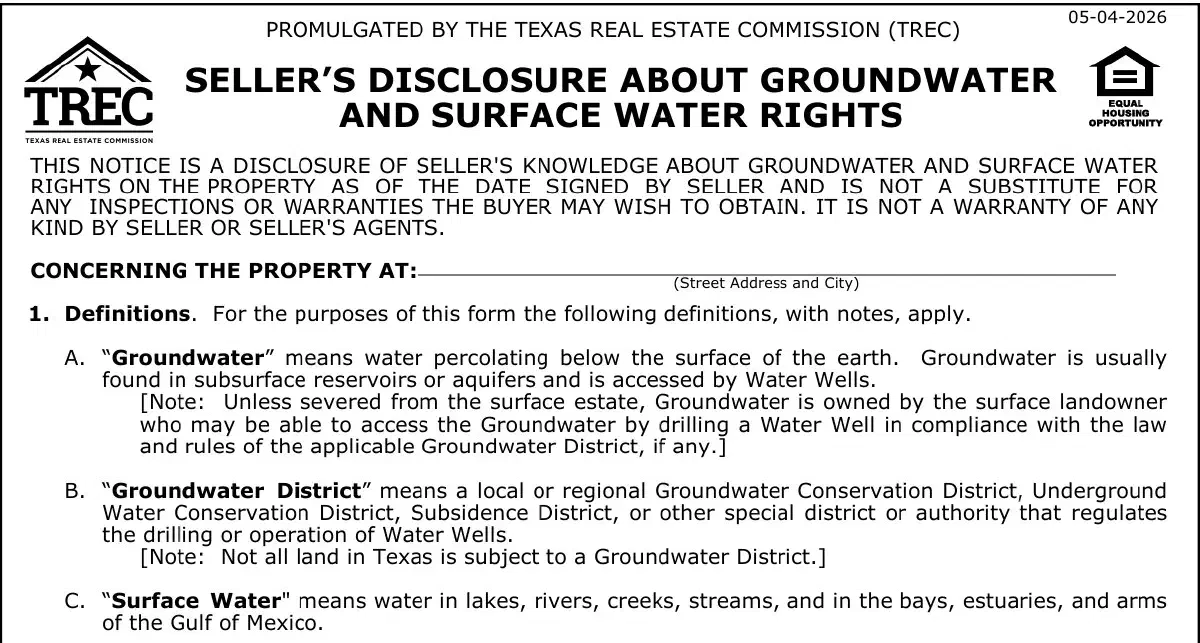
TREC 61-0 is a two-page seller’s disclosure about water: whether the property is in a groundwater district, what water wells are on it and who owns them, whether groundwater rights have been severed, sold or leased, whether the seller owns surface water rights, and whether there’s a pond, lake or water tank. TREC lists it with an effective date of July 1, 2026; the form is dated 05-04-2026.
Like the Seller’s Disclosure Notice, it opens by saying it’s a disclosure of the seller’s knowledge as of the date signed, “not a substitute for any inspections or warranties,” and “not a warranty of any kind by Seller or Seller’s agents.”
Why TREC Created It
TREC says it created the form and added the contract language “following direction from the Sunset Advisory Commission’s special-purpose review of TREC’s disclosure requirements.” The Sunset Commission directed TREC to add language to its contracts that gives buyers “relevant information about groundwater and surface water rights associated with a property.” (TREC FAQ, August 14, 2026)
The important consequence: no statute requires this disclosure. TREC’s FAQ puts it plainly: unlike the Seller’s Disclosure Notice, which Property Code Section 5.008 requires on most resales, the water disclosure “is not required to be provided by another law.” It’s required because the TREC contract says so. Use a TREC contract and Paragraph 7 decides whether the seller has to deliver it.
When Is the Seller’s Water Disclosure Required?
Under a TREC contract other than the condominium contract, the disclosure is required unless every one of five conditions is true. TREC’s FAQ calls delivery “the default.” The seller is excused only by checking box (3) in the water paragraph, which requires all of these:
- (a) the seller isn’t aware of a water well on the property, in use or not
- (b) the seller isn’t aware of a pond, lake or water tank on the property
- (c) the seller isn’t aware of any TCEQ certificate of adjudication, certified filing or permit for surface water rights
- (d) the seller isn’t aware that any groundwater rights have been severed, sold or leased, in whole or in part
- (e) the property receives water only from a named city, MUD or other special district, water supply corporation or private water supply company
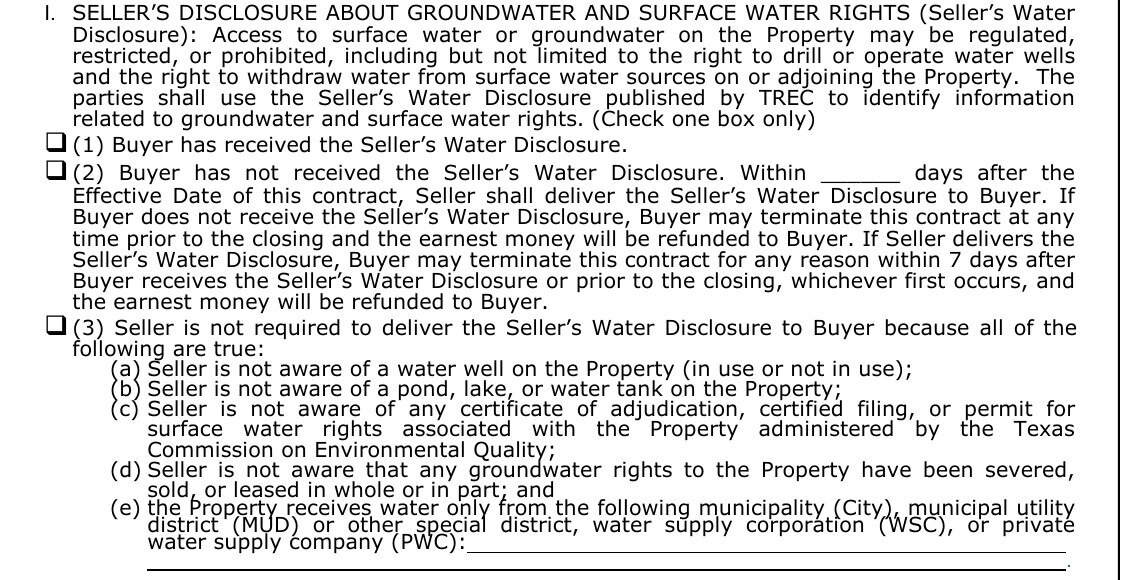 Paragraph 7I of the One to Four Family Residential Contract (Resale), TREC No. 20-19 (05-04-2026). Source: Texas Real Estate Commission.
The other two boxes: (1) the buyer has already received the disclosure, or (2) the buyer hasn’t, and the seller will deliver it within a stated number of days after the Effective Date.
Where it is in each contract
| Contract | Paragraph |
|---|---|
| One to Four Family Residential (20-19) | 7I |
| Unimproved Property (9-18) | 7F |
| New Home, Completed Construction (24-20) | 7J |
| New Home, Incomplete Construction (23-20) | 7K |
| Farm and Ranch (25-17) | 7K |
The Residential Condominium Contract (30-18) doesn’t have it. The previous resale contract (20-18) has no water paragraph either, which is one more reason an old template is a problem. For the full list of 2026 form numbers, see TREC’s 2026 form changes.
What TREC’s FAQ says about the gray areas
TREC has already answered the questions agents ask most. Paraphrasing its FAQ:
- A lake next door doesn’t count. A lake that borders the property isn’t a lake “on the Property.”
- A creek running through doesn’t count either. Under the contract language, a river or creek, including a seasonal or wet-weather creek, isn’t relevant to whether the exception applies.
- A groundwater district alone doesn’t trigger it. If all five statements are true, the seller doesn’t have to deliver 61-0, even inside a groundwater conservation or subsidence district.
- “Pond” and “water tank” aren’t defined. They carry their ordinary meaning. If the seller isn’t sure whether something counts (TREC’s examples are a rain barrel or a koi pond), “the best practice may be to assume it is included.”
- Seller’s Disclosure Notice exemptions don’t carry over. The 5.008 exemptions come from the statute; the water disclosure comes from the contract. TREC says a file could need both, neither, or one but not the other.
TREC also says its Broker-Lawyer Committee plans to review the definition of “water tank,” whether “stream” should be addressed, and what it means to “receive” water. Expect the language to change eventually, though TREC says no changes are expected immediately.
Who Fills It Out and Who Delivers It?
The seller completes and signs it, and the seller delivers it to the buyer. The contract makes delivery the seller’s obligation (“Seller shall deliver the Seller’s Water Disclosure to Buyer”), and the form has signature lines for the seller and acknowledgment lines for the buyer, plus initials for both on page 1.
In practice, the listing agent gets the form in front of the seller, ideally at listing, along with the Seller’s Disclosure Notice. The buyer’s agent gets it to the buyer and returns the signed acknowledgment. The contract’s water paragraph is filled out at the client’s direction like any other term.
A few things nobody on the agent side should do: answer the water rights questions for the seller, decide that a feature “isn’t really a pond,” or explain what rights the buyer is getting. The form’s own notices send those questions to an attorney.
When the box isn’t clear before an offer, TREC’s suggestion is simple: ask the listing agent before submitting. If that doesn’t settle it, the buyer can offer with box (2) checked, and the seller can counter with box (1) or (3).
What the Form Asks
Section 1: Definitions
The form defines five terms, with notes: Groundwater, Groundwater District, Surface Water, Surface Water Rights and Water Well. Two notes are worth reading out loud to anyone new to rural files. Unless severed from the surface estate, groundwater is owned by the surface landowner. And “Not all land in Texas is subject to a Groundwater District.”
“Surface Water Rights” has a narrow meaning on this form: a permit, certified filing or certificate of adjudication administered by the TCEQ that authorizes the diversion, impoundment or use of surface water.
Section 2: Groundwater and water wells
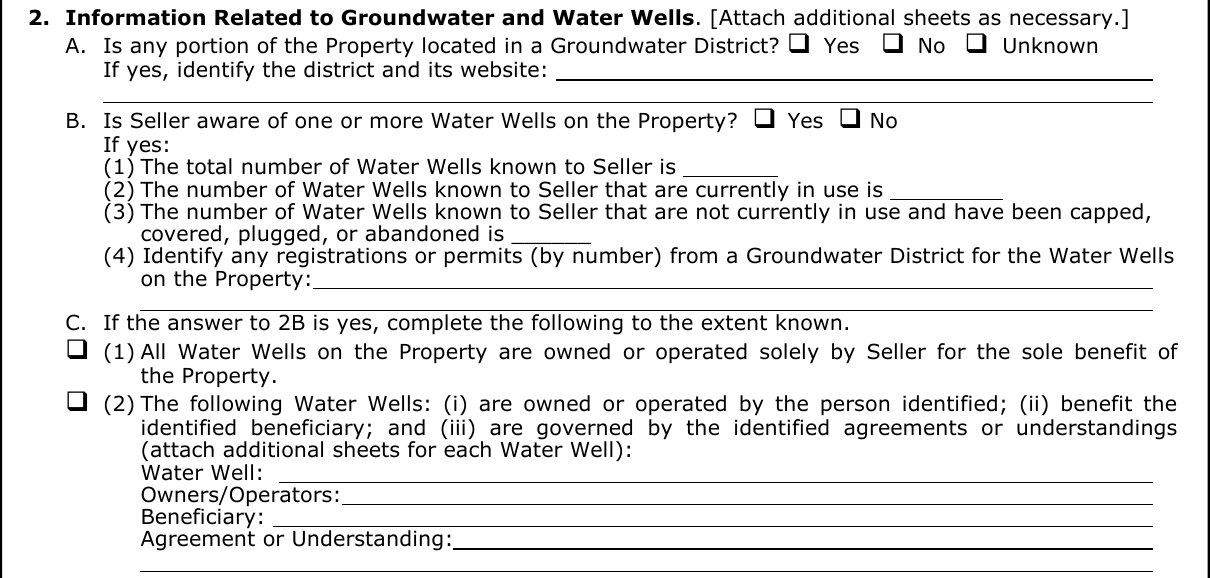 TREC No. 61-0 (05-04-2026), page 1, Section 2. Source: Texas Real Estate Commission.
- 2A: Is any part of the property in a Groundwater District? Yes, no or unknown. If yes, name the district and its website.
- 2B: Water wells known to the seller: the total, how many are in use, how many are capped, covered, plugged or abandoned, and any groundwater district registration or permit numbers.
- 2C: Whether all wells are owned or operated solely by the seller for the property, or, for each well, who owns or operates it, who benefits, and what agreement or understanding governs it.
- 2D: Whether the property gets water from a well on another property (not counting a city, MUD or other special district, water supply corporation or private water company), and the agreements governing access.
- 2E: Whether a well on the property relies on groundwater rights owned or leased from land outside the property.
- 2F: Whether any groundwater rights to the property have been severed, sold or leased, with or without the right to drill or operate a well.
Section 3: Surface water, then the notices
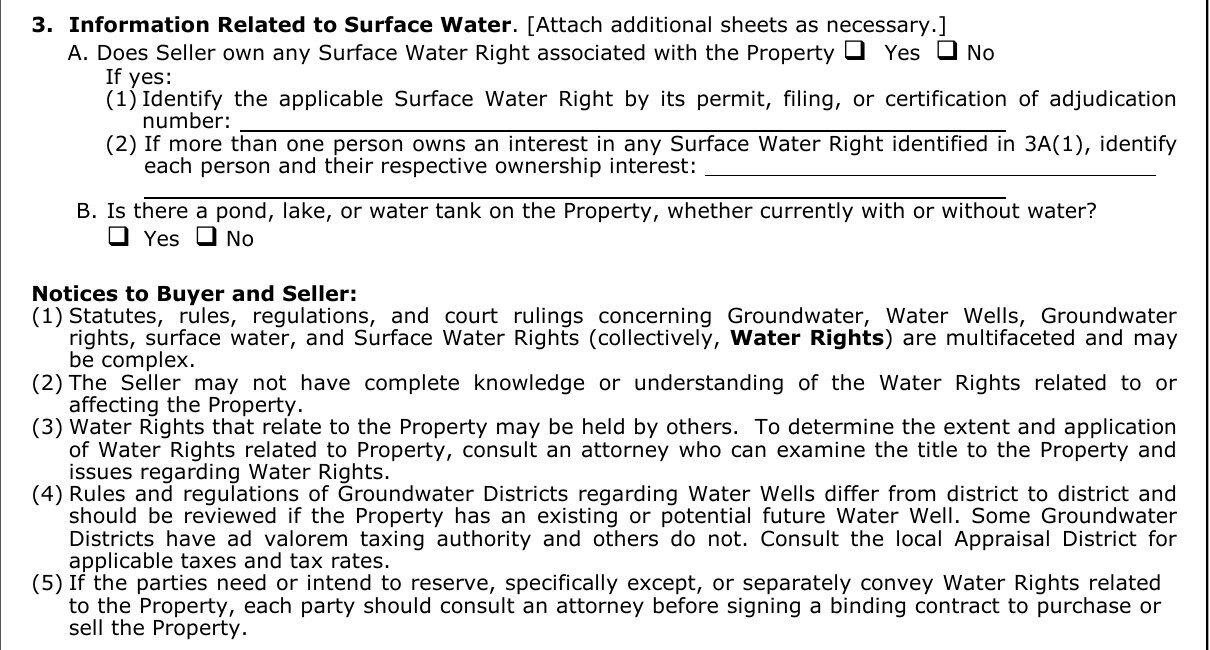 TREC No. 61-0 (05-04-2026), page 2, Section 3 and the Notices to Buyer and Seller. Source: Texas Real Estate Commission.
- 3A: Does the seller own any surface water right associated with the property? If yes, identify it by permit, filing or certificate of adjudication number, and list any co-owners and their interests.
- 3B: Is there a pond, lake or water tank on the property, “whether currently with or without water”?
Five notices follow. They say water rights law “may be complex,” the seller may not fully know or understand the water rights, rights may be held by others, groundwater district rules differ (and some districts can tax), and parties who intend to reserve, except or separately convey water rights “should consult an attorney before signing a binding contract.”
Common Mistakes
Checking box (3) and leaving (e) blank. The exception requires naming the city, MUD, water supply corporation or private water company. TREC’s FAQ specifically says: “don’t forget to complete the blank in (3)(e).”
Checking box (3) on a property with a stock tank or pond. Box (3) needs all five conditions. City water doesn’t help if there’s a tank out back. Neither does a dry one: 3B asks about a pond, lake or tank “whether currently with or without water.”
Assuming “exempt from the Seller’s Disclosure Notice” covers it. An estate sale or a foreclosure may skip the 5.008 notice and still need 61-0 under the contract.
Assuming a groundwater district means it’s required. It doesn’t, on its own. The district question shows up on both disclosures, but it isn’t one of the five box (3) conditions.
Leaving answers blank. TREC’s guidance to sellers is to read the questions and instructions, complete the form accurately and not leave required information incomplete.
Not calendaring the window. If box (2) is checked and the disclosure arrives after the Effective Date, the buyer may terminate for any reason within 7 days after receiving it or before closing, whichever comes first. If it never arrives, the buyer may terminate any time before closing. Either way the earnest money comes back.
Using an old contract. The 20-18 resale contract has no water paragraph at all. If the file opened after July 1, 2026, the contract version is the first thing to check.
Where It Fits in the File
Think of 61-0 as a second Seller’s Disclosure Notice that only some files need. It shows up in the same places, at the same points in the timeline:
- At listing. The seller completes the Seller’s Disclosure Notice and, if any box (3) condition isn’t true, 61-0, since a TREC contract will call for it. Both go in the listing file.
- In the MLS and offer stage. The buyer’s agent knows which box to expect. If the listing shows a well, a pond or a rural water co-op, box (3) is unlikely.
- At contract. Exactly one box in the water paragraph is checked. Box (1) means a signed 61-0 is in the file. Box (2) has a number of days filled in. Box (3) has the water provider named.
- On delivery. The date the buyer receives 61-0 is recorded, the buyer signs the acknowledgment, and the 7-day termination window goes on the calendar.
- Before closing. The signed disclosure, with both sets of initials on page 1, is in the file for the broker’s review.
We don’t complete disclosures and we don’t decide which box applies. That’s the seller, the agents and, when water rights are actually at stake, an attorney. What we do is check that the box, the form and the dates agree, and flag the gap to the agent the day we see it. The rest of the rural-file list is in our guides to well and septic transactions in Texas and the farm and ranch checklist.
Seller’s Disclosure Notice (TREC 55-1): required by Property Code Section 5.008 on most resales of a single dwelling unit; due on or before the Effective Date; statutory exemptions. See our guide to the current Seller’s Disclosure Notice.
Seller’s Water Disclosure (TREC 61-0): required by the TREC contract (not the condo contract) unless all five box (3) conditions are true; delivered as the contract’s water paragraph provides; the 5.008 exemptions don’t decide it.
The Honest Take
On a subdivision house with city water, 61-0 is one checkbox and a name in a blank. On anything with a well, a tank or land, it’s a real disclosure with a real termination right attached, and it’s new enough that plenty of files will get it wrong for a while. The fix isn’t complicated: decide the box at listing, not at the offer, and track the delivery date like you track the option period.
Agents: our TCs check the water paragraph and every other disclosure on your Texas files, with a dedicated TC and a backup on each one. See our Texas TC services, pricing, or get in touch.
TCs: our TC Training Course covers the contract-to-close workflow this form plugs into.
The Closing Table — Monthly Tips from the Contract-to-Close Experts
One email per month. No spam. Unsubscribe anytime.
Related Articles
- TREC Seller’s Disclosure Notice: What Changed in 2026 (and 2023): the current 55-1 and its seven new questions
- TREC’s 2026 Form Changes: the new contract numbers, 61-0, 62-0 and IABS 1-2
- What Is a Seller’s Disclosure?: the statutory notice, exemptions and the 7-day right
- Well and Septic Transactions in Texas: the rest of the rural-file checklist
- The TREC 20-19, Paragraph by Paragraph: where Paragraph 7 fits in the contract