
A Leaseback Is a Lease, Not a Favor
Closings and move-out dates don’t always line up. When your seller needs a few more days in the house after closing, the TREC Seller’s Temporary Residential Lease is how it gets documented. The buyer owns the home, and your seller stays on as the buyer’s tenant.
It’s common, and it usually goes fine. When it doesn’t, it’s almost always because the terms were treated as an afterthought: a blank holdover amount, no insurance call, or a lender who found out the week of closing.
Table of Contents
▼What the TREC 15-7 Is
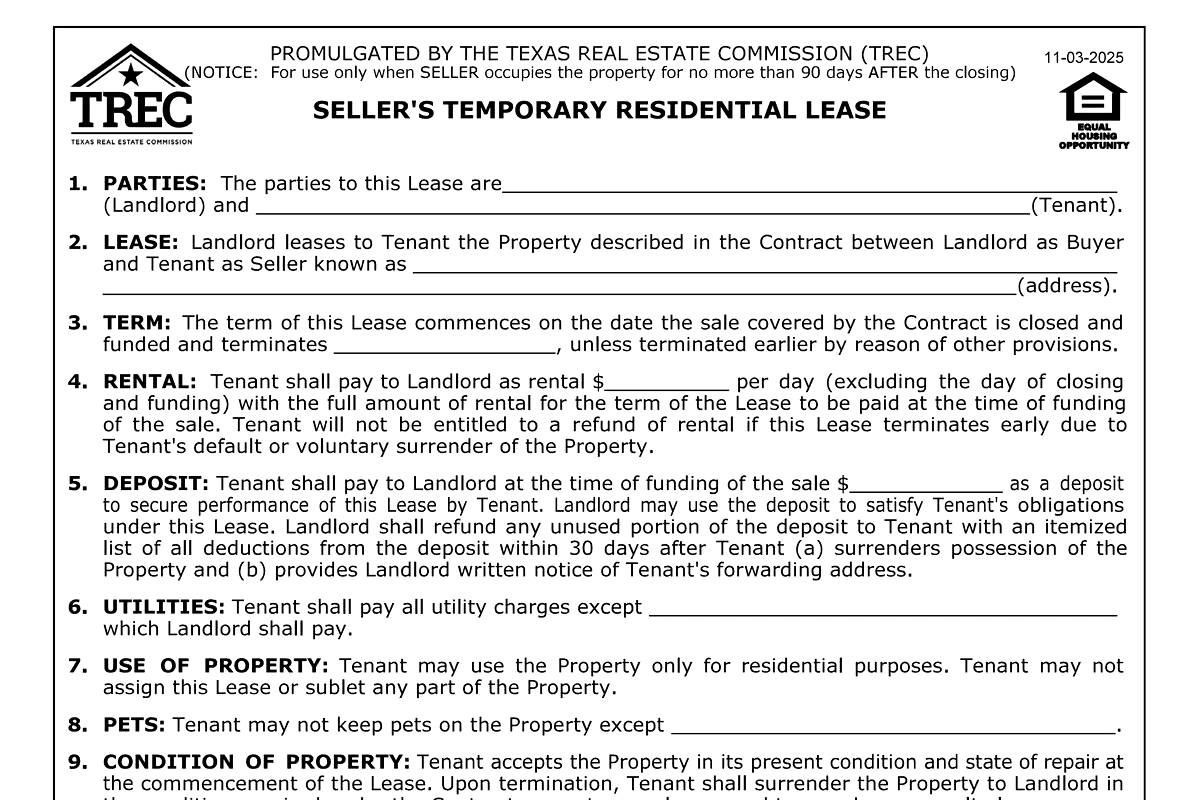
The current form is TREC No. 15-7, dated 11-03-2025, which replaced TREC 15-6. It’s a two-page TREC-promulgated lease. The notice at the top says it’s “For use only when SELLER occupies the property for no more than 90 days AFTER the closing.”
The parties flip roles on this form. The buyer becomes the Landlord and the seller becomes the Tenant. The lease term starts on the date the sale closes and funds, and it ends on the date filled in at Paragraph 3, unless it ends earlier under the lease.
The leaseback has to be part of the deal. Paragraph 10A of the TREC resale contract (TREC 20-19) has a box for possession “according to a temporary residential lease form promulgated by TREC or other written lease required by the parties,” and Paragraph 22 lists the Seller’s Temporary Residential Lease as an addendum. The contract also says: “Any possession by Buyer prior to closing or by Seller after closing which is not authorized by a written lease will establish a tenancy at sufferance relationship between the parties.”
In plain terms: if the seller is staying after closing, it should be on this lease, signed by both parties, before closing.
The Terms That Matter
Term (Paragraph 3)
The end date is a blank. The form caps use at 90 days after closing. In our experience, most leasebacks run a few days to two or three weeks, just long enough for the seller to move or close on the next house. If your seller needs more than 90 days, this isn’t the right form, and the parties need a different written lease.
Rent (Paragraph 4)
Rent is stated per day, excluding the day of closing and funding. The full rent for the term is paid at the time the sale funds. The seller doesn’t get a refund of rent if the lease ends early because of the seller’s default or a voluntary move-out.
The daily amount is negotiated. The most common approach we see is the buyer’s daily cost of ownership: principal, interest, taxes and insurance divided by 30. Some deals use more, and some use zero as a concession to win the offer. That’s for the parties to negotiate.
Deposit (Paragraph 5)
The seller pays a security deposit to the buyer at funding. The buyer can use it to cover the seller’s obligations under the lease and must refund the unused portion, with an itemized list of deductions, within 30 days after the seller moves out and gives written notice of a forwarding address.
The amount is a blank, and it’s negotiable. A deposit that’s too small doesn’t give the buyer much protection if the seller overstays.
Utilities, Condition and Repairs (Paragraphs 6, 9 and 14)
The seller pays all utility charges except any the form lists for the buyer. In practice, utilities usually stay in the seller’s name until move-out; switching them at closing while the seller still lives there causes problems.
The seller accepts the property in its present condition and must surrender it in the condition the contract requires, except normal wear and tear and casualty loss. Under Paragraph 14, the seller bears the expense of repairing and maintaining the property during the lease, including the yard, trees and shrubs, unless the Texas Property Code says otherwise.
Insurance (Paragraph 16)
This is the one clients skip. The form says the landlord and tenant shall each maintain the insurance on contents and property each considers appropriate, and it says: “CONSULT YOUR INSURANCE AGENT; POSSESSION OF THE PROPERTY BY SELLER AS TENANT MAY CHANGE INSURANCE POLICY COVERAGE.”
After closing, the seller’s homeowner’s policy typically no longer covers a house they don’t own, and the buyer’s policy may not cover the seller’s belongings or liability. Both clients should call their insurance agents before closing. A renter’s policy for the seller is often the simple answer, but that’s for the seller’s insurance agent to say.
Default, Termination and Holdover (Paragraphs 17 to 19)
- Default: if the seller fails to perform and doesn’t start to fix it within 24 hours after the buyer’s notice, the seller is in default.
- Termination: the lease ends when the Paragraph 3 term expires or on the seller’s default.
- Holding over: possession after the lease ends creates a tenancy at sufferance and doesn’t renew or extend the lease. The seller owes the per-day amount filled in on the form as damages, in addition to the buyer’s other remedies.
Fill in the holdover amount. A blank there leaves the buyer with very little leverage on move-out day.
Issues to Raise With Your Client
Lender Occupancy Rules
If the buyer is financing a home they plan to live in, the loan usually requires the buyer to move in within a set time after closing. The standard deed of trust language we see on most owner-occupied loans allows 60 days. We’ve also seen lenders limit leasebacks to well under the form’s 90 days, or ask to see the lease before closing.
The buyer’s agent should tell the lender about the leaseback as soon as it’s in the offer. Finding out the week of closing that the lender won’t allow it is a bad week for everyone.
The Final Walkthrough
Normally the walkthrough confirms the seller is out and the house is in the condition the contract requires. With a leaseback, the seller is still living there at closing. Buyer’s agents should set that expectation with their buyer, and listing agents should make sure the seller understands the surrender condition at the end of the lease.
A Seller Who Didn’t Want to Sell
The seller has been paid and is still in the house. Most sellers move out on time. But a seller who was forced to sell, for financial or family reasons, may have little reason to hurry, and the holdover amount and deposit may not change that. We’ve seen the cleanest answer be a later closing date instead of a leaseback. If the seller needs time, consider moving closing first.
Put It in the Offer
The leaseback should be in the offer from the start, not raised in closing week. If your seller already knows they’ll need time, say so in the agent remarks so buyer’s agents can plan for it.
What We Don’t Answer
Whether a holdover is enforceable, what the buyer can do to get an occupant out, and what a deposit deduction means for your client are legal questions. Send those to a real estate attorney. The form itself says it in Paragraph 23: consult your attorney before signing if you don’t understand the effect of the lease.
How Our TCs Handle It
Freedom doesn’t manage leases. We don’t collect rent, hold deposits, do move-out inspections or deal with occupancy issues. Our part is the paperwork inside the sale, and it ends at closing:
- We fill out the TREC 15-7 only at your specific written direction. The term, rent, deposit and holdover amounts come from you and your client; we don’t decide or negotiate them.
- We send it to you to review and take to your client, and track signatures from both sides, with you copied on everything.
- We deliver the fully signed lease to the title company with the contract file.
- We keep the lender, title and the co-broke agent updated weekly after the option period, so a lender with a leaseback limit hears about it early.
If something in the lease doesn’t match the contract, like a closing date that moved, we flag it to you right away. What changes is your call and your client’s.