
A One-Page Notice With an Attachment People Forget
Propane service areas are common on rural, acreage and edge-of-town properties, and in some newer subdivisions built around a community propane system. When the property is in one, Texas law requires a specific notice to the buyer. TREC’s form for it is one page. The part that trips up files is the attachment.
Table of Contents
▼What the TREC 47-0 Says
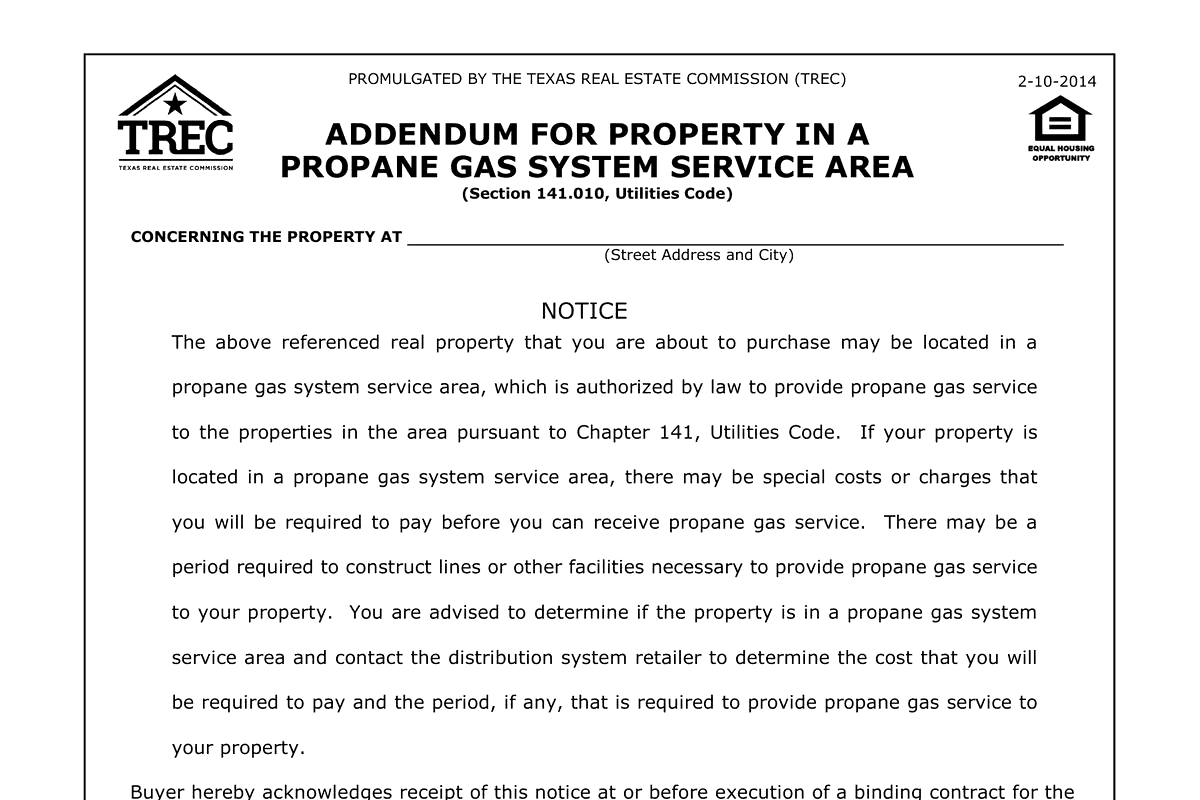
The Addendum for Property in a Propane Gas System Service Area (TREC 47-0) carries the notice from Section 141.010 of the Utilities Code. It tells the buyer three things:
- The property may be in a propane gas system service area that’s authorized by law to provide propane service under Chapter 141 of the Utilities Code.
- There may be special costs or charges the buyer has to pay before receiving service.
- There may be a period needed to build lines or facilities to serve the property.
It advises the buyer to find out whether the property is in a service area and to contact the distribution system retailer about costs and timing.
The buyer acknowledges receipt “at or before execution of a binding contract for the purchase of the above referenced real property or at the closing of the real property.” Both buyer and seller sign.
The Recorded Notice Has to Be Attached
The form says that §141.010(a) requires the notice to include a copy of the notice the distribution system retailer must record in the county real property records, and that a copy of the recorded notice is attached.
Under Chapter 141, the retailer records that notice with a service map and information about customers’ rights. The 47-0 notes that the seller can get a copy from the county clerk’s office where the property is located or from the retailer.
A 47-0 without the recorded notice behind it is incomplete. In our experience, this is the step that gets skipped.
What the Contract Says
Paragraph 6E(9) of the TREC One to Four Family Residential Contract (Resale), TREC 20-19, says that if the property is in a propane gas system service area owned by a distribution system retailer, the seller must give the buyer written notice as required by §141.010 of the Utilities Code. Paragraph 22 lists the Addendum for Property in a Propane Gas System Service Area under Statutory Disclosures and Notices, with the reminder that a seller’s failure to provide applicable notices may give the buyer remedies or termination rights.
How to Spot It
- The seller’s disclosure. The TREC Seller’s Disclosure Notice (55-1) has a Liquid Propane Gas item with boxes for LP Community (Captive) and LP on Property. A “community” or “captive” answer is a strong hint the property is on a retailer’s system.
- No natural gas, but gas appliances. Gas range, water heater or furnace with no gas utility serving the street.
- Subdivision documents. Some developments were built with a single propane provider serving every lot.
- The county records. Search the real property records for a recorded propane service area notice covering the subdivision or area.
When in doubt, ask the seller who delivers their propane and whether it comes from a tank on the property they own, a tank they lease, or a community system.
Service Area vs. a Leased Tank
These are two different issues:
- Service area (47-0). About the retailer’s system and the area it serves. Statutory notice under the Utilities Code.
- Leased tank (fixture lease). About who owns the tank in the yard. Paragraph 4B of the contract and the TREC Addendum Regarding Fixture Leases (52-1). See our fixture lease addendum guide.
A property can need both: a community propane system and a leased tank or meter set. One doesn’t cover the other.
What the Notice Doesn’t Answer
The notice tells the buyer the property is in a service area. It doesn’t cover the cost to set up service, deposits, tank rental or whether the buyer can switch providers. Those answers come from the provider.
Whether a property is legally within a service area, or what remedy a buyer has if the notice was missed, are questions for a real estate attorney.
How Our TCs Handle It
On listings, our listing coordinators track that the 47-0 is in the disclosure packet and tell you if it’s missing. If you need it, we fill it out only at your specific written direction from the provider information you give us, send it to you to review and take to your seller for signature, and upload it to the MLS with the other disclosures.
On contracts, we check that the 47-0 and its attachment are in the file and listed in Paragraph 22, and tell you right away if they’re not. If there’s a leased tank, we make sure the fixture lease addendum is there too and add its deadlines to the deadline timeline, with 48-hour reminders.
We don’t decide whether a property is in a service area. You and your broker make the call.