
The Seller’s Side Has Far Fewer Exits
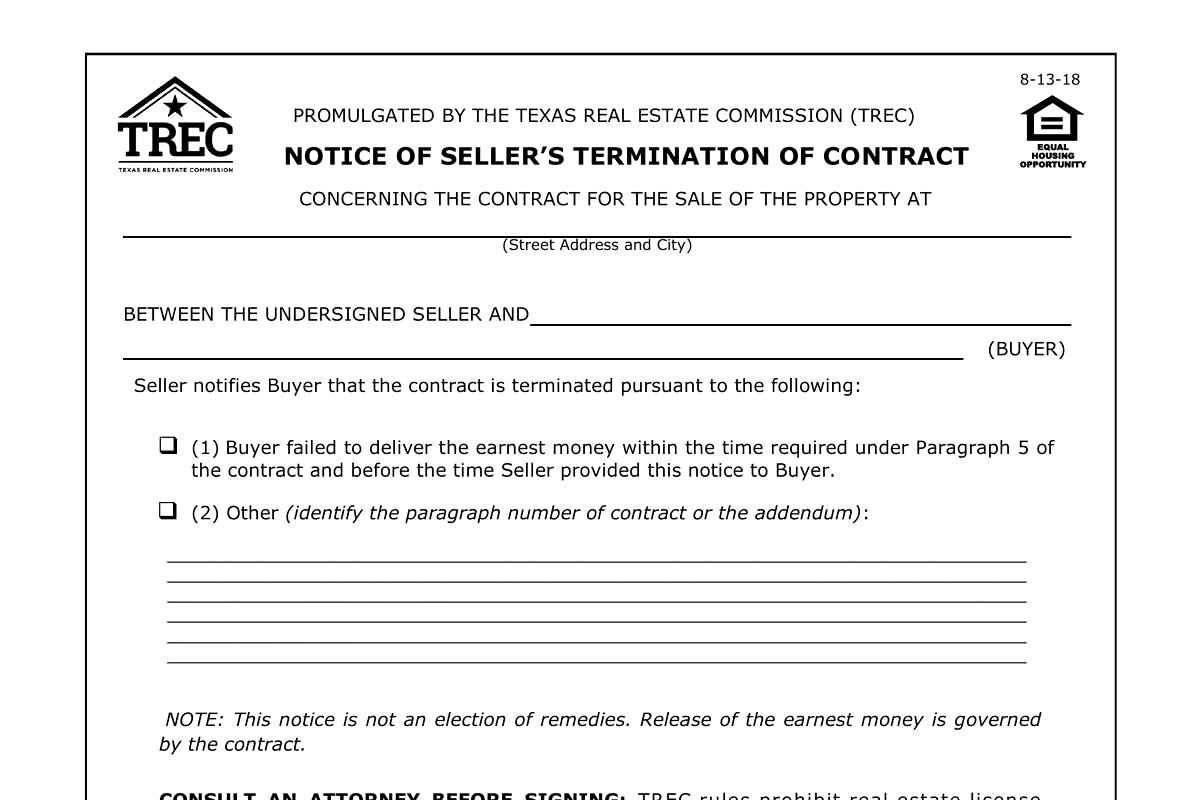
Put TREC’s two termination notices side by side and you can see how the contract is built. The buyer’s notice (38-8) has eight boxes. The seller’s notice, TREC 50-0, Notice of Seller’s Termination of Contract, has two.
That’s not an oversight. Once a seller signs the TREC One to Four Family Residential Contract (Resale), TREC 20-19, their ways out are narrow. This page covers what the form says, where the seller’s rights actually come from, and the timing that decides whether it works.
Table of Contents
▼What’s on the Form
TREC 50-0 identifies the property and the buyer, and then the seller checks one of two boxes. Straight from the form:
- “Buyer failed to deliver the earnest money within the time required under Paragraph 5 of the contract and before the time Seller provided this notice to Buyer.”
- “Other (identify the paragraph number of contract or the addendum).”
The seller signs and dates it. Every seller on the contract signs. The current version is dated 8-13-18 in the top corner, with “TREC No. 50-0” in the footer, and it’s free on TREC’s forms page.
Box 1: The Buyer Didn’t Deliver the Earnest Money
This is the clearest seller termination right in the contract, and the timing rule is strict.
The deadline. Under Paragraph 5A of TREC 20-19, the buyer must deliver the earnest money and option fee to the escrow agent within 3 days after the Effective Date. If the last day falls on a Saturday, Sunday or legal holiday, it moves to the end of the next day that isn’t one.
The right. Straight from Paragraph 5C: “If Buyer fails to deliver the earnest money within the time required, Seller may terminate this contract or exercise Seller’s remedies under Paragraph 15, or both, by providing notice to Buyer before Buyer delivers the earnest money.”
The catch is in the last few words. The seller has to give notice before the buyer delivers. If the earnest money shows up at title on day five and the seller hasn’t sent the notice yet, this right is gone. That’s why the form’s box 1 repeats it: the failure has to be “before the time Seller provided this notice.”
Paragraph 5E makes time of the essence for all of Paragraph 5.
Timing and proof. Box 1 only works if the notice goes out before the buyer delivers, and title’s records show what was or wasn’t received and when. Whether to terminate is your seller’s decision, made with you and your broker. If there’s any question about whether the right exists, that’s for a real estate attorney.
Box 2: “Other”
Box 2 is a blank where the seller names the paragraph of the contract or addendum they’re relying on. The form doesn’t create any rights. The seller needs a real one somewhere in the contract.
The one we see most often is buyer default under Paragraph 15. If the buyer fails to comply with the contract, Paragraph 15 says the seller may enforce specific performance or seek other relief, or terminate and receive the earnest money as liquidated damages. Whether the buyer is actually in default, and which remedy fits, are legal questions. That’s a conversation for the seller’s attorney before the seller signs.
Some addenda give the seller rights too. If the contract includes the Addendum for Sale of Other Property by Buyer, read that addendum for how its notices and deadlines work rather than assuming.
What doesn’t belong in box 2: “Seller changed their mind.” “Seller got a better offer.” “Seller doesn’t like the closing date anymore.” None of those is a termination right. Paragraph 19 lets the seller keep showing the property and accept back-up offers, but the first contract stays in place.
The Cost of a Termination Without Grounds
A seller who terminates without a contractual basis may be the one in default. Under Paragraph 15, if the seller fails to comply with the contract, the buyer may enforce specific performance (ask a court to make the seller close), seek other relief, or terminate and receive the earnest money. Paragraph 17 adds attorney’s fees for the prevailing party in a legal proceeding.
In our experience, sellers who want out are usually better served by a mutual agreement with the buyer, put in writing and signed by both sides, than by a one-sided notice. Either way, the seller should talk to their attorney before signing anything.
What the Notice Doesn’t Do
Just like the buyer’s version, the form says it in plain words: “This notice is not an election of remedies. Release of the earnest money is governed by the contract.”
Terminating the contract and moving the earnest money are two separate steps. Under Paragraph 18 of TREC 20-19, either party or the escrow agent may send a release of earnest money for both sides to sign. If a party won’t sign, either party may make a written demand on the escrow agent.
In our experience, title companies don’t decide on their own to pay one side over the other’s objection. Most files wait until everyone signs, and a title company may file an interpleader and let a court sort it out. Who’s entitled to the earnest money is a question for a real estate attorney.
Delivering It So It Counts
- In writing, to the addresses in Paragraph 21. The contract lists the notice addresses for each party. Use them.
- Every seller signs. Two sellers on the contract means two signatures.
- Keep proof of the time. On a box 1 termination, the whole question is whether the notice went out before the earnest money arrived. Save the sent email with its timestamp, and get title’s receipt time in writing.
How Our TCs Handle It
On every file, we track the earnest money and option fee deadlines from the Effective Date and confirm receipt with title. If the earnest money isn’t receipted by the deadline, we tell you right away, so you can talk with your seller and your broker while the Paragraph 5C right still exists. Whether to terminate is your seller’s call, not ours. We don’t decide it, advise on it or negotiate it.
When you tell us your seller is terminating, we:
- Fill out the TREC 50-0 only at your specific written direction, with the box and any paragraph you give us
- Send it to you to review and take to your seller
- Track every seller’s signature, with you copied on everything
- Deliver the signed notice to the buyer’s agent and to title
- Fill out the release of earnest money only at your specific written direction and track signatures from both sides
- Confirm with title once the earnest money is disbursed, and close out the file in your broker’s compliance system
We never handle the money. If the buyer’s side disputes the termination, that’s between you, your broker, your seller and their attorney.