
The HOA Addendum Is Where the Money and the Deadlines Live
On a property with a mandatory HOA, the contract already tells the buyer they’ll be a member. What it doesn’t do is say who orders the resale certificate, who pays for it, how long the buyer has to review it, or who covers transfer fees. That’s the job of the HOA addendum, and a blank left wrong on it is how a smooth file turns into a closing-week argument.
Table of Contents
▼What the Contract Already Says
Paragraph 6E(2) of the TREC One to Four Family Residential Contract (Resale), TREC 20-19, has a checkbox for whether the property is subject to mandatory membership in a property owners association. If it is, the paragraph gives the buyer the §5.012 Property Code notice: membership is mandatory, the restrictions are recorded, assessments can change, and failing to pay can lead to foreclosure of the association’s lien. It also explains that §207.003 entitles an owner to the governing documents and a resale certificate.
It ends with: “If Buyer is concerned about these matters, the TREC promulgated Addendum for Property Subject to Mandatory Membership in a Property Owners Association(s) should be used.”
The TREC 36-11 Addendum, Paragraph by Paragraph
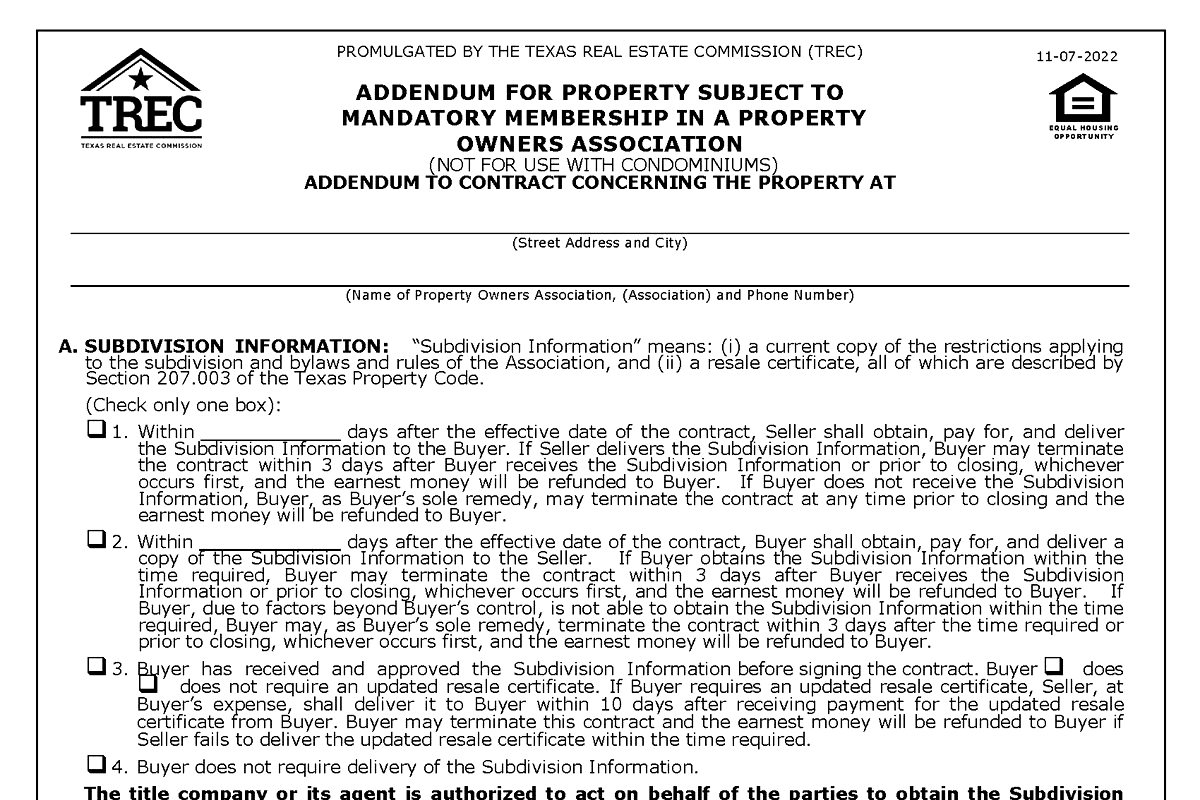
The current form is TREC 36-11, the Addendum for Property Subject to Mandatory Membership in a Property Owners Association. It replaced 36-10 in the 2026 form update (TREC form changes for 2026). It’s not for condominiums.
Paragraph A: Subdivision Information. “Subdivision Information” means the restrictions, bylaws and rules, plus a resale certificate, as described in §207.003 of the Property Code. Check only one box:
- A(1) The seller obtains, pays for and delivers it within the number of days filled in. The buyer may terminate within 3 days after receiving it or before closing, whichever comes first, with the earnest money refunded. If the buyer never receives it, the buyer’s sole remedy is to terminate any time before closing.
- A(2) The buyer obtains it at the buyer’s expense within the days filled in. The same 3-day termination right applies.
- A(3) The buyer already received and approved it before signing, and either does or doesn’t require an updated resale certificate. If an update is required, the seller delivers it at the buyer’s expense within 10 days after the buyer pays for it.
- A(4) The buyer doesn’t require it.
The title company can order the Subdivision Information only after it receives the fee from the party obligated to pay.
Paragraph B: Material changes. If the seller learns of a material change, the seller must notify the buyer. The buyer can terminate before closing if any of the information wasn’t true, or if there’s a material adverse change before closing.
Paragraph C: Fees and deposits for reserves. The buyer pays association transfer fees, deposits, reserves and similar charges up to a dollar amount filled in, and the seller pays any excess. Regular dues that are prorated under Paragraph 13 and the costs covered by Paragraphs A and D don’t count. If this paragraph conflicts with the fees in the Subdivision Information, the addendum controls.
Paragraph D: Authorization. The seller authorizes the association to release the information. If the buyer doesn’t require the Subdivision Information and title still needs information from the association (dues status, special assessments, violations, a right-of-first-refusal waiver), a checkbox says whether the buyer or the seller pays title for it.
The form also carries a notice that the association may be solely responsible for certain repairs, and the buyer shouldn’t sign if they’re concerned about those repairs unless they’re satisfied the association will make them.
What’s in the Resale Certificate
Section 207.003 of the Property Code sets the contents and the timeline. TREC also publishes a resale certificate form for associations to use, TREC 37-5. Among other things, the certificate covers:
- Any right of first refusal or other restraint on transfer
- The regular assessment, how often it’s charged, and any approved special assessment coming due
- The total unpaid amounts owed to the association for the property
- Approved capital expenditures and the amount of reserves
- The current operating budget and balance sheet
- Unsatisfied judgments and pending lawsuits the association is a party to
- Insurance covering the common areas
- Known violations on the property and any governmental health or housing code notices
- The managing agent’s contact information and the association’s transfer-related fees
Timing and fees. The association has until the 10th business day after it receives a written request. The statute caps the fee for the certificate and for an update, and the association can’t charge a fee if it doesn’t deliver on time.
What Slows Down HOA Closings
- The wrong box in Paragraph A. Two boxes checked, or a blank number of days, creates a deadline nobody can calculate.
- Nobody ordered it. Title can’t order until it’s paid. If A(1) puts it on the seller, someone has to make sure the payment happened.
- Open violations. A violation shows up on the certificate, and the buyer’s agent will ask about it. Unresolved ones can turn into a repair negotiation late in the file.
- Unpaid balances. Past-due dues and fines become part of what title has to clear before funding.
- Fees above the Paragraph C cap. Transfer fees, capital contributions and reserve deposits can add up. If the total is over the cap, the seller pays the difference, and some sellers find that out at closing.
How Our TCs Handle It
We fill out the TREC 36-11 only at your specific written direction: which box in Paragraph A, the number of days, the Paragraph C cap and the Paragraph D payer come from you and your client. We don’t choose them, and we don’t negotiate them.
Then we:
- Send the completed addendum to you to review and take to your client, and track signatures
- Confirm with title that the resale certificate has been ordered and who’s paying for it
- Add the delivery deadline and the buyer’s 3-day termination window to the deadline timeline as soon as we know the delivery date, with 48-hour reminders to you
- Deliver the certificate to you when title sends it, so you can get it to your client
- Keep title, the lender and the co-broke agent updated weekly after the option period, and send you a Monday key-dates report and a Thursday status report
If the certificate shows a violation or a balance due, we tell you right away. What happens next is between you, your broker and your client.