
The Request That Comes Up When Dates Don’t Line Up
The buyer’s lease ran out. The buyer sold their last house and the closings are a week apart. The lender pushed closing. Whatever the reason, the buyer’s agent asks whether the buyer can move in early.
The TREC Buyer’s Temporary Residential Lease is the form for it. In our experience it’s also one of the riskiest things a seller can agree to, and we’ve seen it go wrong enough times that our first answer is to look for another way.
Table of Contents
▼What the TREC 16-7 Is
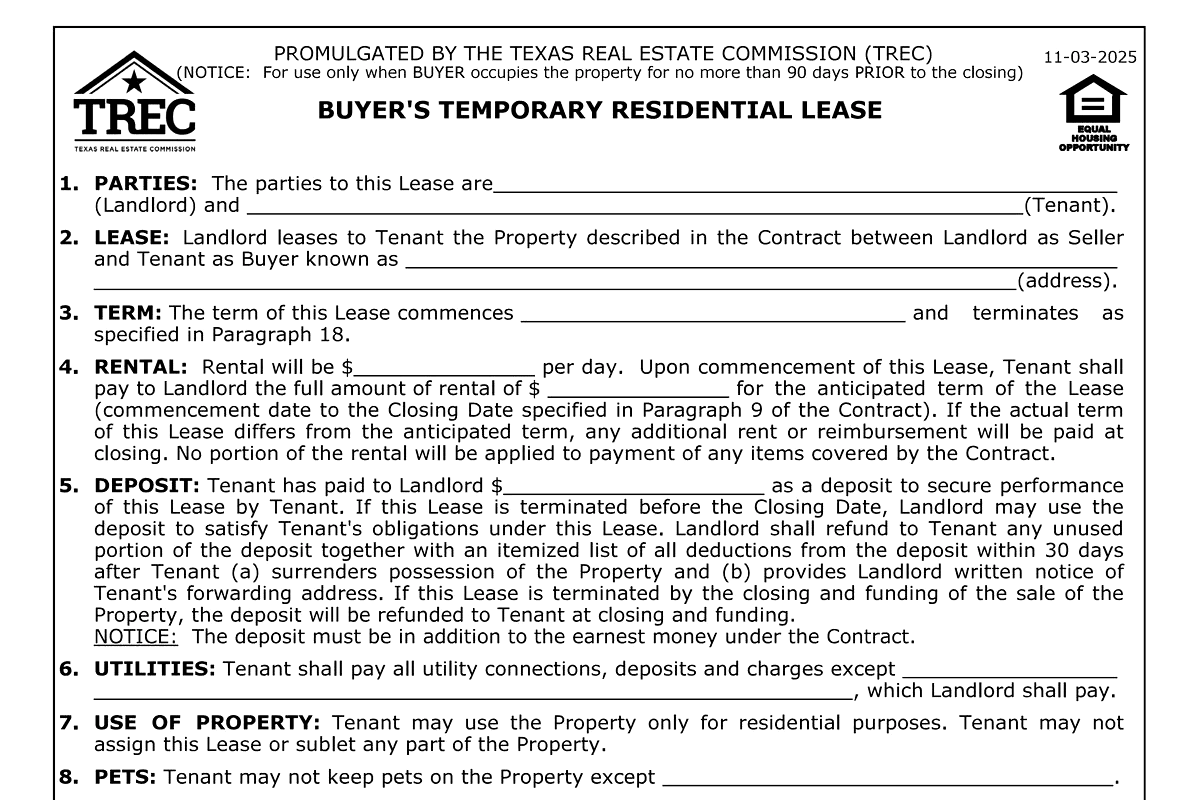
The current form is TREC No. 16-7, dated 11-03-2025, which replaced TREC 16-6. The notice at the top says it’s “For use only when BUYER occupies the property for no more than 90 days PRIOR to the closing.”
The seller is the Landlord and the buyer is the Tenant. Paragraph 10A of the TREC resale contract (TREC 20-19) allows possession under a TREC temporary residential lease, and Paragraph 22 lists the Buyer’s Temporary Residential Lease as an addendum. Without a written lease, the contract says possession by the buyer before closing creates a tenancy at sufferance.
What the Form Says
Term (Paragraph 3). Starts on the date filled in and ends as described in Paragraph 18.
Rent (Paragraph 4). A daily amount. When the lease starts, the buyer pays the full rent for the anticipated term, from move-in to the closing date in the contract. If the actual term is different, the difference is settled at closing. None of the rent applies to anything covered by the contract.
Deposit (Paragraph 5). The buyer pays a deposit to secure the lease. If the lease ends before closing, the seller may use it to cover the buyer’s obligations and must refund the rest, with an itemized list of deductions, within 30 days after the buyer moves out and gives a forwarding address. If the lease ends by closing and funding, the deposit is refunded at closing. The form’s notice: “The deposit must be in addition to the earnest money under the Contract.”
Utilities (Paragraph 6). The buyer pays all utility connections, deposits and charges except any the form lists for the seller.
Condition (Paragraph 9). The buyer accepts the property in its present condition, but the seller still has to make the repairs the contract requires. If the lease ends before closing, the buyer surrenders the property in its present condition, as improved by the seller, except normal wear and tear and casualty loss.
Alterations (Paragraph 10). The buyer can’t put holes or nails in the woodwork, floors, walls or ceilings, can’t alter, paint or decorate, and can’t install improvements or fixtures without the seller’s prior written consent.
Repairs and maintenance (Paragraph 14). The buyer bears the expense of repairing, replacing and maintaining the property, including the yard, trees, shrubs and all equipment and appliances, unless the Texas Property Code says otherwise.
Insurance (Paragraph 16). Each party maintains the insurance on contents and property it considers appropriate. The form warns: “CONSULT YOUR INSURANCE AGENT; POSSESSION OF THE PROPERTY BY BUYER AS TENANT MAY CHANGE INSURANCE POLICY COVERAGE.”
Default (Paragraph 17). If the buyer fails to perform and doesn’t start to fix it within 24 hours after the seller’s notice, the buyer is in default.
Termination (Paragraph 18). The lease ends on "(a) closing and funding of the sale under the Contract, (b) termination of the Contract prior to closing, (c) Tenant’s default under this Lease, or (d) Tenant’s default under the Contract, whichever occurs first." If it ends any way other than closing, the buyer must surrender possession.
Holding over (Paragraph 19). Possession after termination creates a tenancy at sufferance and doesn’t renew or extend the lease. The buyer owes the per-day amount filled in on the form, in addition to the seller’s other remedies.
Why We’re Cautious About It
The form is clear on paper. Here’s what we’ve seen in practice.
The Deal Fails With Someone Living There
Financing falls through, the appraisal comes in short, or the buyer’s job changes. The contract terminates, and so does the lease, but the buyer is still in the house. If they don’t leave, the seller is looking at a legal process to get them out, while still carrying the mortgage, taxes and insurance on a house they can’t put back on the market in any real way.
The Seller’s Insurance May Not Cover It
The form says it in capital letters. A homeowner’s policy written for an owner-occupied or vacant house may not respond the same way with someone else living there. If someone gets hurt or something gets damaged, the coverage question gets complicated. The seller should call their insurance agent before agreeing to anything.
The Buyer Starts Finding Problems
Living in a house is different from a 30-minute showing or an inspection. The faucet that sticks, the outlet tied to a switch, the gate latch. Things the seller lived with become things the buyer wants fixed before closing, and now that conversation happens with the buyer already in the house.
Changes Before Closing
The form prohibits painting, nail holes and alterations without written consent. We’ve still seen buyers treat the house as theirs before it is. If the sale closes, nobody cares. If it doesn’t, the seller has a house that’s been changed, and the deposit may not cover it.
The Leverage Shifts
A buyer sleeping in a hotel wants to close. A buyer already living in the house has less reason to push the lender. Meanwhile the seller can’t move back in and is carrying every cost.
Whether a seller can recover damages, enforce the holdover amount or remove an occupant are legal questions. If the seller is considering early occupancy, or it’s already gone wrong, they should talk to a real estate attorney.
Alternatives to Raise First
Before your seller agrees, ask whether one of these solves the buyer’s problem:
- A hotel or short-term rental. A few nights cost far less than a failed closing with an occupant.
- A faster closing. If the buyer needs the house sooner, the answer may be pushing the lender and title to close sooner, not early occupancy.
- Move the closing date. An amendment is simpler than a lease.
- A leaseback on the buyer’s sale. If the buyer is selling a home, they may be able to stay there after that closing under a seller’s temporary lease, which keeps the timing problem on their side.
- Storage and family. Not glamorous, but a storage unit and a spare room for a week works.
If the Seller Agrees Anyway
It’s the seller’s decision. If they agree, these are the points we see agents raise with their clients:
- Rent that covers at least the seller’s daily carrying costs, not a token amount
- A real deposit, which by the form’s notice is on top of the earnest money
- A written walkthrough with photos and video before move-in
- Calls to both insurance agents before move-in
- A short term, tied tightly to the closing date
- A filled-in holdover amount
- Confirmation from the buyer’s lender that the loan is on track, before move-in rather than after
How Our TCs Handle It
Freedom doesn’t manage leases. We don’t collect rent, hold deposits, hand over keys or deal with occupancy. Our part is the paperwork inside the sale:
- We fill out the TREC 16-7 only at your specific written direction. The dates, rent, deposit and holdover amounts come from you and your client; we don’t decide or negotiate them, and we don’t advise for or against the lease.
- We send it to you to review and take to your client, and track signatures from both sides, with you copied on everything.
- We deliver the fully signed lease to the title company with the contract file.
- We add the move-in date to the deadline timeline, alongside the contingency dates we already track with 48-hour reminders.
- If the closing date moves, we flag right away that the lease term and rent may need to be addressed. What happens next is between you, the other agent and your clients.