

How Do I Become A Certified Transaction Coordinator?
If your state requires you to have a certification prior to working as a real estate transaction coordinator, you’ll need to obtain the certification from a source that’s recognized by your state real estate commission. There is currently only one state that mandates certification to act as a TC and that’s California.
Table of Contents
▼Do I Need To Be Certified To Work As A Transaction Coordintor?
In every state we’ve reviewed, the answer is no. You do not need to have or maintain a certification to work as a Transaction Coordinator unless you’re working with licensed agents from California.
It definitely helps if you have real estate experience and a good online course can give you an edge as long as the course focuses on the mechanics of how to work as a TC - review the curriculum carefully.
I Saw A List Of TC Certifications, What About Those?
When we were researching for this article we ran across other blog posts and websites that listed TC certifications too, but when we went looking for those certifications, they either didn’t exist any longer or they never existed at all.
Resumecat’s list of Transaction Coordinator Certifications
Resumecat lists eleven (11) different Transaction Coordinator Certification Courses. We were only able to verify one course that still existed - that course was for Certified Transaction Coordinator (CTC) from the California Association of Realtors.
Let us save you some energy, here are the associations and certifications she listed and what we were able to find out about each.
1. Certified Transaction Coordinator (CTC)
This is the California TC certification for individuals wanting to work as a TC in California. It’s offered on CAR’s (California Association of Realtor) official store and is only available through there.
2. Certified Real Estate Transaction Coordinator (CRTC)
Offered by RENI (Real Estate Negotiation Institute), this organization doesn’t appear to exist any longer as the website listed on their Linkedin page leads to a website that no longer exists.
3. Certified Real Estate Closing Professional (CRCP)
Offered by ALTA (American Land Title Association), this organization is still very much in existence, however, we were not able to locate the mentioned certification in ALTA’s course catalog.
4. National Association of Realtors Transaction Coordinator Certification (NAR-TCC)
NAR (National Association of Realtors), still in existence and they offer a vast number of certifications and training courses and certifications (31 certifications at the time of this article). We were not able to find any mention of a Transaction Coordinator Certification (TCC), though from experience we do know that NAR occasionally changes its certification classes and offerings, so while there’s not a TCC cert today, it’s worth checking in with them periodically.
5. Certified Residential Real Estate Transaction Coordinator (CRRETC)
Also supposedly offered by NAR (National Association of Realtors), but again, we were unable to find any mention of the course on NAR’s website or by doing focused Google searches.
6. Certified Home Closing Professional (CHCP)
Another NAR (National Association of Realtors) course that we were unable to locate information on.
7. American Escrow Association Certified Transaction Coordinator (AEACTCC)
AEA (American Escrow Association) still exists and it offers two certifications, neither of them is a Transaction Coordinator Certification though.
8. National Notary Association Certified Transaction Coordinator (NNACTCC)
The National Notary Association is still in existence, however, we were not able to find anything related to Transaction Coordinator Certifications on their site or in their training catalog.
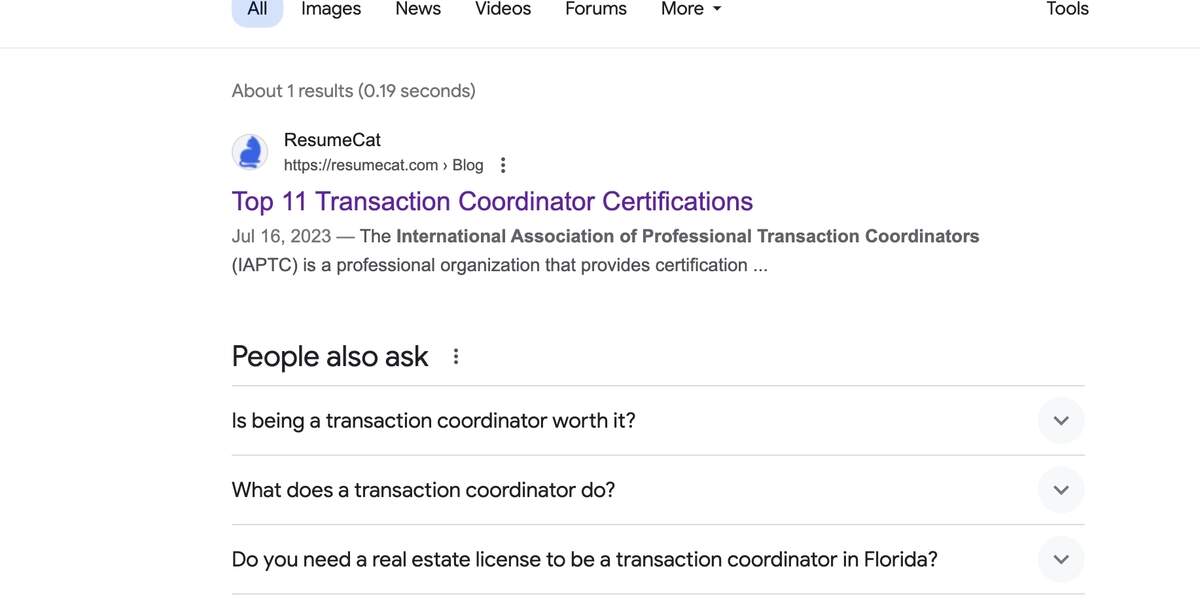
9. International Association of Professional Transaction Coordinators Certification (IAPTC-TCC)
Not only could we not find this organization, we couldn’t even find a trace of it ever having existed. All searches we made trying to find this association lead us back to Resumecat’s blog post.
10. Institute of Real Estate Management’s Certified Transaction Coordinator Program (IREM-CTC)
IREM (Institute of Real Estate Management) still exists. Their certification page lists only three certifications: CPM – Certified Property Manager, ARM – Accredited Residential Manager, and ACoM – Accredited Commercial Manager. No mention could be found of anything even remotely resembling a TC Certification course.
11. National Homebuyers Alliance Certified Transaction Coordinator Program (NHACTCP)
NHBA (National Homebuyers Alliance) exists, but it appears to be focused exclusively on helping home buyers purchase a home. In fact, NHBA’s Facebook page lists them as a Credit Counseling Service. No mention of a Transaction Coordinator Program.
Real Estate Transaction Coordinators Association
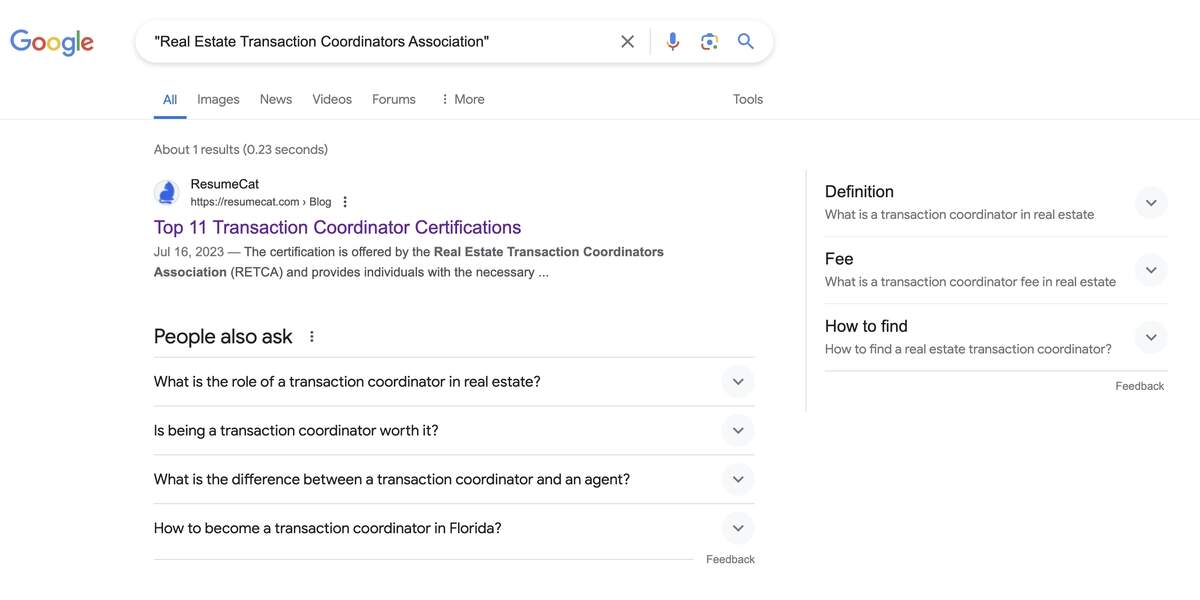
Near the bottom of Resumecat’s article, in the FAQs About Transaction Coordinator Certifications, there is mention of Real Estate Transaction Coordinators Association (RETCA) that purportedly certifies TC’s, but again, we were unable to locate even a mention of this association on the internet. Our search kept returning us to Resumecat’s blog post.
Conclusions about Resumecat’s list of TC Certifications
We were only able to turn up a single certification being offered, it was specific to TCs working with CAR agents. The rest of the article was suspect as none of the organizations mentioned (if the org even existed) had a cert that was related to Transaction Coordination.
There is so much information on the internet and so many people trying to get into the field of Transaction Coordination, we felt that doing the research for you to help uncover some of the misinformation would be beneficial.
Certification or Certified?
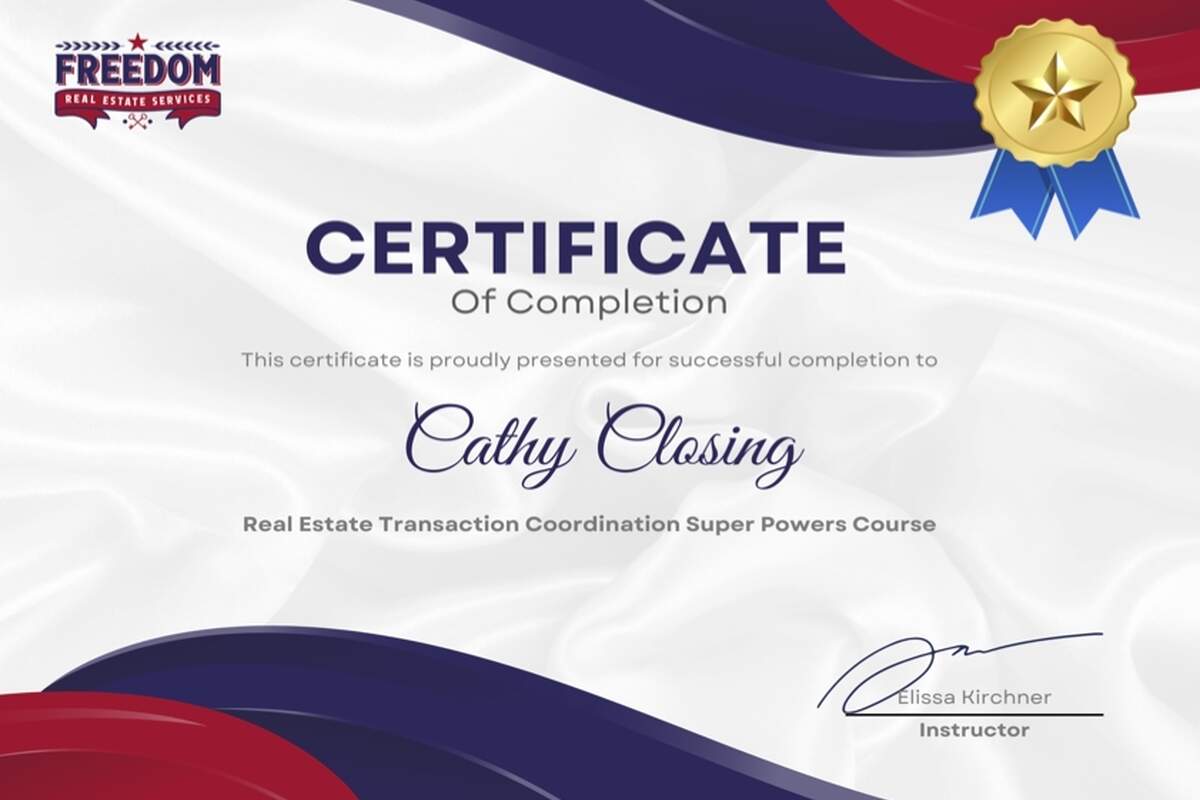
There are a great number of TC Training Classes out there, some even state they offer certification, but we have been unable to find a single TC Course that is recognized by a state agency or a Realtor’s Association to meet a minimum required standard to work as a TC. Many courses offer a certificate, but none appear to offer a recognized certification - a subtle, but important distinction.
🔍 Find Out More About Our TC Training Course! 🔍
Ok, Where Do I Get Transaction Coordinator Training?
There are a great number of courses available on the internet, and if you have the financial resources, we suggest taking multiple courses as no course covers every single facet of being a TC, and after you’ve taken a few courses, we suggest reaching out to a local TC company and seeking a position.
Need TC help now? Skip the newsletter and get in touch — we'd love to talk about how we can support your business.
Want to become a TC? Check out our TC Training Course.
